


Magazine Archive
Home -> Magazines -> Issues -> Articles in this issue -> View
The Bangle Angle | |
The BanglesArticle from International Musician & Recording World, June 1986 | |
The fabbest four since the last Fab Four talk to us about real Pop, American style
The Californian Fab Four talk of their love of music, the power of vocal harmony and good old fashioned values.

l to r: Debbie Peterson, Vicki Peterson, Susanna Hoffs, and Mickey Steele
Image credit: Joe Bangay
It was the understanding of atypical parents and their love of Rock'n'Roll that encouraged the formation of The Bangles. Sisters Vicki and Debbie Peterson were brought up in a San Fernando Valley household that literally rocked around the clock almost from the day they were born.
"Our parents love music," says Debbi. "They'd wake us up to watch The Beatles when they were on The Ed Sullivan Show. We have an intercom system in the house that was on all the time, so we'd always be listening to music and singing along."
And if they were not in the house, they were – like all good California Girls – in an open-topped car, singing along to the radio. It's not surprising that the sisters were soon making music of their own. Debbi picked up her first pair of drumsticks at the tender age of 15 and admits to being "an air drummer" for quite some time before that.
"I used to go into my room and listen to records," she says, laughing, "and sort of air drum along with them. I loved music so much and I really wanted to be a performer."
Today, Debbi, 23, beats on a five-piece Gretsch drum kit and Zildjian cymbals (22" ride, 20" and 18" crashes, and 14" hi hat). As far as sticks go, she'll grab "whatever is around, though I usually use Calato Regal Tips."
Debbi's first taste of the stage came via her older sister, Vicki, who asked her to join her high-school band, Aisha.
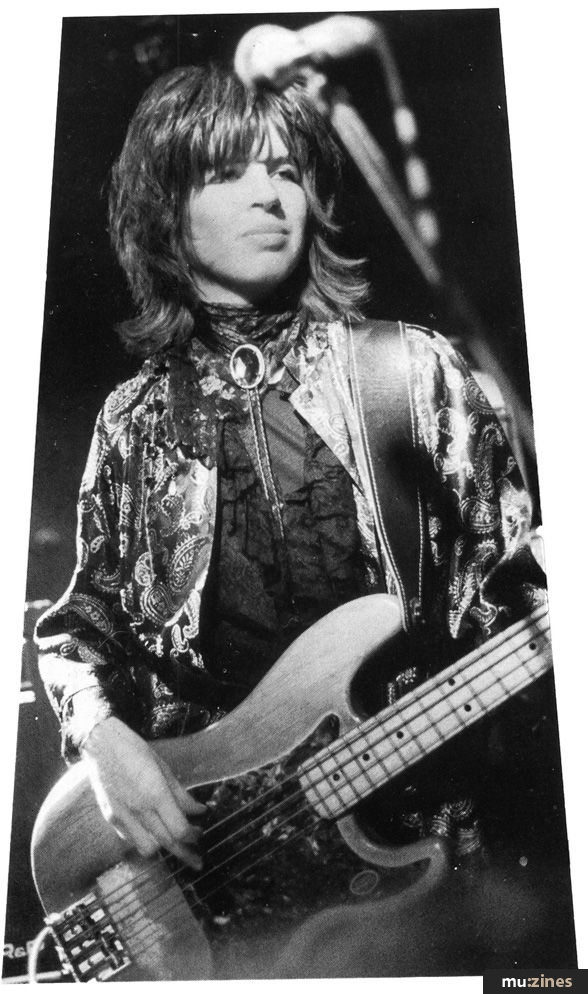
Image credit: Joe Bangay
"It was très esoteric," recalls Debbi with a chuckle, "very arty, you know. Actually Aisha is the name of Stevie Wonder's daughter and means 'life'."
In high-school, Vicki sang in madrigal groups, which is where she developed her love of choral singing. Her favourite bands were those that deployed vocal harmonies: The Beatles, The Hollies, Fleetwood Mac and The Eagles. This fondness for vocalese tends to overshadow the fact that she is also a competent lead guitarist. Vickie now plays a pair of late-model Gibson Les Paul Customs.
"One I play mainly on stage," she says. "It's got an overdrive with a really good killer-bee fuzz-tone."
Her amplification is prone to a lot of chopping and changing.
"The way I would like to do an album is to go in with songs... turn on the tape machine and play them." Vicki
"I have been playing through a Fender Super Reverb and a Marshall Combo, but I think I'm either going to switch to a more powerful amp or just get another Super Reverb and have it really souped up. I'm just in love with the Fender sound and the natural overdrive, and you just can't get them from these Heavy Metal amps I've been playing through." As for effects, Vicki favours the Boss Super Overdrive and is contemplating acquiring a digital-delay unit.
In January 1981, the Peterson sisters decided to form another band and found guitarist Susanna Hoffs through the musicians wanted section in a Los Angeles music paper. Hoffs, now 26, had never been in a band before (she'd been busy getting her art degree at Berkeley), but was keen to join one. As a guitarist she was, and still is, a devotee of the Rickenbacker sound, playing Rickenbacker six and 12-strings, with three quarter size bodies and full scale necks. At present, she's playing through Vicki's Marshall Combo amp with no effects.
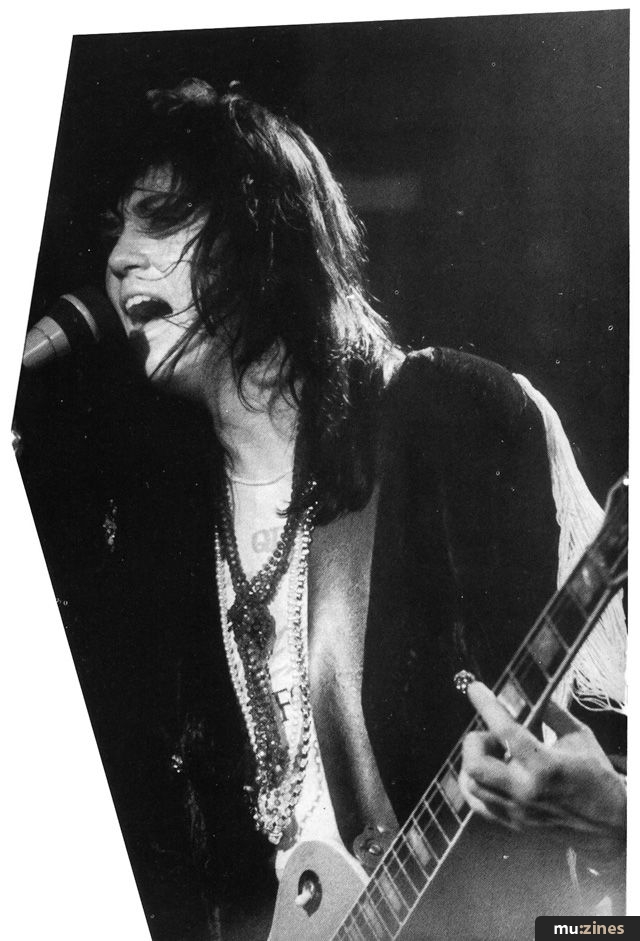
Image credit: Joe Bangay
Playing bass with them at that time was Annette Zilinskas, who's since joined new Stiff signing Blood On The Saddle, and who was later to be replaced by Micheal ('Mickey') Steele. Before she teamed up with Vicki, Debbi and Susanna, Mickey was singing in a band that lacked a bass-player. Rather than getting one to join the job fell to her. The group in question was The Runaways – LA's notorious jailbait band whose lineup was assembled and career masterminded by rock entrepreneur Kim Fowley. Initially The Runaways were a trio comprised of Steele, Joan Jett and Sandy West, but before their days of infamy, Steele was unceremoniously given the boot by the dictatorial Fowley.
"He said, 'Look, you're a good singer," she remembers, "but you can't play bass and you have absolutely no charisma.' That whole thing was very weird and very Monkees-like. Kim Fowley is very much a Svengali type. He wants to be a Rock star real badly, but he can't do it himself, so he keeps finding these young talented people to guide."
After this experience, Steele withdrew from the LA music scene. At one point in the pre-Bangles era, Susanna Hoffs attempted to contact her about putting together a band, but the battle-scarred Steele didn't return her calls. A few years later, Vicki Peterson thought of Steele as a replacement for the departed Annette Zilinskas, but, as Steele relates, "Susanna went, 'I don't know, I think she's kind of stuck up.' Because I'd kept not answering her calls, you see." She laughs loudly. All's well that ends well.
"I ended up moving into the house Vicki lived in, then I auditioned for the job and it worked so well, so..."
So, indeed: together they've gone through a number of name changes – from The Colors to The Bangs to The Bangles and at the end of last year completed their second album, Different Light. The recording of the album was arduous; as drummer Debbi puts it, everyone involved shares a "great fat feeling of relief" that it's now behind them. But there's euphoria mixed in with the relief, because they like the record and have waited a long time for the world to hear it. The world, for its part, would seem to be feeling quite a bit of affection for The Bangles these days – affection which made itself manifest in the phenomenal sales of their single (taken from the album and written by their friend, Prince) – Manic Monday – which zoomed into the top 10 with apparent ease. Many fans believe that The Bangles are the closest thing to a Fab Four in Pop music at the moment: they have an enthusiasm that harks back to the naive innovations of The Beatles and a whole generation of unselfconscious pure-Pop purveyors. In the male dominated world of Rock music, they have made their own way without falling into any of the "women in Rock" pigeonholes. By their very naturalness, they make the whole issue of gender immaterial.
But back to the album. Different Light puts some adventurous spins on the basic Bangles sound.
"It's really fulfilling to be in a band that can stand around a mike, open its mouths, and all the parts fall into place." Vicki

Image credit: Joe Bangay
"It's a come-out-of-the-garage album," says Susanna. "More prominent this time out are keyboards, textural effects and harmonies. Lots of harmonies," she adds. "They've really become integrated into the songwriting this time."
All four Bangles sing, and their voices fall into a natural top-to-bottom order, with Susanna the first soprano and Vicki the second soprano, while Debbi and Mickey fill out the alto register.
"It's really fulfilling to be in a band that can stand around a mike, open its mouths, and the parts kind of fall into place," says Vicki.
Though they love unadulterated choral singing, they still go armed with guitars and drums on tour. And keyboards too.
"On the first album, keyboards were used very much as padding," says Vicki, "and they are featured on Different Light. We got some real fun keyboard sounds – we did a Hammond B3 organ, and we did a harpsichord on Manic Monday. You know, you strum through it, and you're missing it. So we have to take a keyboardist with us on tour."
They experimented, too, with drum machines. On one song from Different Light "Walk Like An Egyptian" Debbi is pre-empted by a Linn Drum. Not that it worries her...

Image credit: Joe Bangay
"It's a technical kind of song, and the Linn is perfect for it," she explains. "When we play it live, I'll just bring percussion stuff out and have the Linn play the drum parts. I'll get to dance around and be an idiot!"
Lest you worry that The Bangles are going techo-pop, breathe easy.
"I tend to stick to old-fashioned values — I like to play all my drum parts" Debbi
"I tend to stick to old-fashioned values," says Debbi. "I like to play all my drum parts. That kind of drum technology is good if it's used to help the sound, but if it's going to be replacing someone, that's where I draw the line."
In the studio The Bangles spend a lot of time experimenting with sounds; the sessions for Different Light – produced by David Kahne – lasted all last summer. But on stage they tend to eschew a lot of technical fuss and bother and aim for a high-energy performance. In the wake of Different Light's difficult delivery, one can forgive The Bangles for sounding a mite drained. Says Vicki:
"The way I would like to do an album – which is hopefully, dear God, how we're gonna do the next one – is to go in with songs that we're comfortable with, that we've played live and that we know inside out, and just turn on the tape machine and play them."
That's how The Bangles made their first records: a self-produced single called Getting Out Of Hand (on their own label – Downkiddie Records) and a five song mini album, Bangles, for Faulty Records. The latter, which sold 35,000 copies, was recorded and mixed in just three days.
These days, they talk half-jokingly about becoming bigger than their childhood idols, The Beatles, and they rhapsodise about their long-time favourites – Fairport Convention, The Yardbirds, The Merry-Go-Round, Big Star and The Beach Boys.
"The Beach Boys... I don't know, there's something about that blend they've got, when I hear it, it sends shivers down my spine," Mickey Steele gushes. "I mean, that stuff, we're talking serious, serious obsessive things."
"That kind of emotional response – you can't get that from anything," adds Vicki. "It's wonderful. That's why music should exist."
Interviewing The Bangles is more than just another cordial encounter with strangers; it's like being in the back bedroom of some teenage yesteryear when the air was clean and music meant everything. One gets the feeling that The Bangles are moved to make music almost as a form of homage to those whose songs brightened their own youths.
Yet, despite all the embellishments they've added to the foundation. The Bangles remain The Bangles. As Susanna Hoff stresses: "We are still a Rock band underneath it all."
Publisher: International Musician & Recording World - Cover Publications Ltd, Northern & Shell Ltd.
The current copyright owner/s of this content may differ from the originally published copyright notice.
More details on copyright ownership...

International Musician - Jun 1986
Interview by Parke Puterbaugh, Jacqui Deevoy
Help Support The Things You Love
mu:zines is the result of thousands of hours of effort, and will require many thousands more going forward to reach our goals of getting all this content online.
If you value this resource, you can support this project - it really helps!
Donations for June 2026
Issues donated this month: 0
New issues that have been donated or scanned for us this month.
Funds donated this month: £0.00
All donations and support are gratefully appreciated - thank you.
Magazines Needed - Can You Help?
Do you have any of these magazine issues?
If so, and you can donate, lend or scan them to help complete our archive, please get in touch via the Contribute page - thanks!
If you're enjoying the site, please consider supporting me to help build this archive...
...with a one time Donation, or a recurring Donation of just £2 a month. It really helps - thank you!

 @mu_zines
 RSS Feed
 Blog
Blog