


Magazine Archive
Home -> Magazines -> Issues -> Articles in this issue -> View
Master Cuts | |
The Master RoomArticle from International Musician & Recording World, July 1975 | |
Cutting masters is a fine art. George Peckham discusses the problems

George Peckham
One of the great unrecognised arts of the music industry is the cut. Producers and a few enlightened artists are prepared to travel halfway across the world to cut a master with the right cutting engineer.
Cutting studios swing in and out of fashion like dance rhythms and just a few years ago Apple cutting was the place to cut. Today Apple has gone and a new centre in London has sprung up.
The Master Room in London's Riding Horse Street has been building almost a cult-following among more aware producers in the year it's been open and it has the distinct advantage of ex-Apple cutting engineers George Peckham and Tony Bridge doing the business.
The Master Room is a highly individual and specialised operation. It was set up specifically to be the only specialised cutting studio in London by Freddie Packham, Bryan Hewson, Tony and George. The policy of specialisation has proved highly successful and George and Tony now spend an incredible number of hours per week cutting masters and high quality acetates.
Among the Master Room's recent successes has been the Wings' superb Venus And Mars.
"It was quite easy to cut really," recalls George, "But it was quite long on one side, just over 23 minutes, and the other side is around 20. A few years ago people were putting longer time on to disc, but now that we're getting a bit more level on, it has to be a bit shorter. The best playing time is around 20 minutes really."
Just a few years ago, cutting engineers were boasting that they could get 28 minutes on a side with no loss of level, but that was before engineers got cheeky, and began to question the equipment manufacturer's specifications regarding level. "A few engineers refused to accept that and so now and again a cheeky one would put more level on than he should — including me. The result was that cutting engineers found they could get more level without any more distortion than the equipment manufacturers suggested and because of the level, the optimum cutting time was reduced. The subsequent increase in sound quality was well worth the loss in playing time.
But cutting engineers can only be as good as the tapes they are supplied with. Within limits they can improve a poor quality tape, but the limits are quite narrow.
"About 50 per cent of the tapes that arrive are good, the other 50 per cent poor, needing a lot of work. The biggest single problem in cutting is dynamic range. When you limit and equalise you've got to be really careful to watch which frequencies you are adding to because if you add at the wrong frequencies it will go flying way over the top and you'll have to limit all the more and the end result is a rotten sound.
"So many new engineers have appeared on the scene who don't understand the needs of the cutting engineer. In the old days an engineer started as the-brusher-up-come-tea-boy and then he'd learn how to copy tapes doing a transfer, then he'd go to the cutting room and from there he'd go to the studio. And because he had to go through these three or four steps by the time he got to the end he'd understand the whole process."
In addition to working within the limitations of the cutting lathe, the thoughtful engineer also has to work with the producer or artist during the cutting process. "Some clients, whether they are producers or artists, have exceptionally fine ears. Ian Anderson has an excellent pair of ears for example. In that situation they hear everything you do. To get the end result you might try to clip some of the frequencies a little bit, but he'd be able to hear what you'd done and you'd have to leave it alone. Half the ability to hear is natural, the other half is attunement which is the result of long hours in the studio. You've got to have it before you can train it."
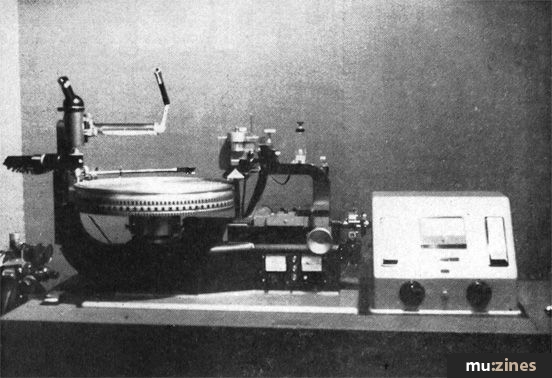
In an effort to get the maximum level whilst holding the dynamic range within an acceptable level, is it possible to slip limiters in and out during a cut?
"You can, but only within circuit. You can't really put the whole limiter in and out because of the possibility of clicks and bangs. The problem with that is that if you're going to use a limiter it's got to be in circuit all the time so you're using another set of amplifiers or you're adding distortion all the time. You want to try and avoid click and distortion. Records are bad enough as it is. The companies are re-cycling plastic like good-oh so the quality is bad enough as it is."
Engineers traditionally are a little resentful about the interference of artists and producers over what is, after all, mainly a technical operation. About 50 per cent of artists and producers attend the cut and George makes a point of trying to achieve exactly what they want.
"Everybody is urging you to give your best on a cut. What they don't realise is that I'm only going to give my best anyway. Many times I've cut something that I would have preferred to sound better, but I don't think it's been my fault. I really try as hard as possible on every single cut."
As a long established cutting engineer at Apple and at the Master Room, George has cut many, many chart singles and albums. But which one presented him with the greatest challenge before giving him particular satisfaction?
"Abbey Road. That was quite a long album but I managed to get a good level on it. I'm really pleased about that one, but I must admit it wasn't all down to me because the tapes were good anyway. Geoff Emerick was recording and he's a great engineer, he went through all the steps I mentioned before. He's got two Grammy awards for his engineering so he should know what he's doing. That made it so much easier for me to get on to disc as loud as possible."
One problem of course is that many artists don't understand the need for clarity on a cut. "A lot of bands say to me, 'I don't care if it's dirty, just get the level on'. But the thing always comes back to me a month or so later when the pressing jumps so we have to do a re-cut my way. Usually the head of the record company is the man who insists on a decent cut."
"One of the things that makes me weep is what happens to some of my cuts when the pressing plant gets hold of it. I've had some really disgusting pressings back and of course we get the blame."
So has the Master Room ever considered setting up a pressing plant?
"It's something I'd like to do. It's very costly, very involved and very time-consuming. It would be beautiful to cut the record and then press it perfectly and make sure the public get exactly what was recorded. Lots of people send us the test pressing and ask us to O.K. it: If we don't, it has to be re-cut and they have to pay for it. There's several ways they can mess a cut-up. When they make up the metal electrolysis stage, when metal is transfered across onto the lacquer itself, they transfer at the wrong heat, and the bass seems very woolly. Then on the production stage when they clean the disc up, you lose all the top if they over polish."
More with this topic
 Cut It Out |
 Making Records (Part 1) |
 DIY Music - All You Need To Know About Making Your Own Records |
 Masters Of The Universe |
 Mastering at Home |
 Past Masters - Sound Mastering |
 Strawberry Cutting Room |
Browse by Topic:
Mastering
Publisher: International Musician & Recording World - Cover Publications Ltd, Northern & Shell Ltd.
The current copyright owner/s of this content may differ from the originally published copyright notice.
More details on copyright ownership...
International Musician - Jul 1975
Donated & scanned by: Mike Gorman
Feature by George Peckham
Help Support The Things You Love
mu:zines is the result of thousands of hours of effort, and will require many thousands more going forward to reach our goals of getting all this content online.
If you value this resource, you can support this project - it really helps!
Donations for May 2026
Issues donated this month: 0
New issues that have been donated or scanned for us this month.
Funds donated this month: £0.00
All donations and support are gratefully appreciated - thank you.
Magazines Needed - Can You Help?
Do you have any of these magazine issues?
If so, and you can donate, lend or scan them to help complete our archive, please get in touch via the Contribute page - thanks!
Please Contribute to mu:zines by supplying magazines, scanning or donating funds. Thanks!
Monetary donations go towards site running costs, and the occasional coffee for me if there's anything left over!

 @mu_zines
 RSS Feed
 Blog
Blog