


Magazine Archive
Home -> Magazines -> Issues -> Articles in this issue -> View
Article Group: | |
Master Class | |
Article from International Musician & Recording World, June 1986 | |
An education in computer music
MUSICOM computer software, distributed by Roland UK, is the world's first ever complete musical education package, from vocal techniques to jazz rock.
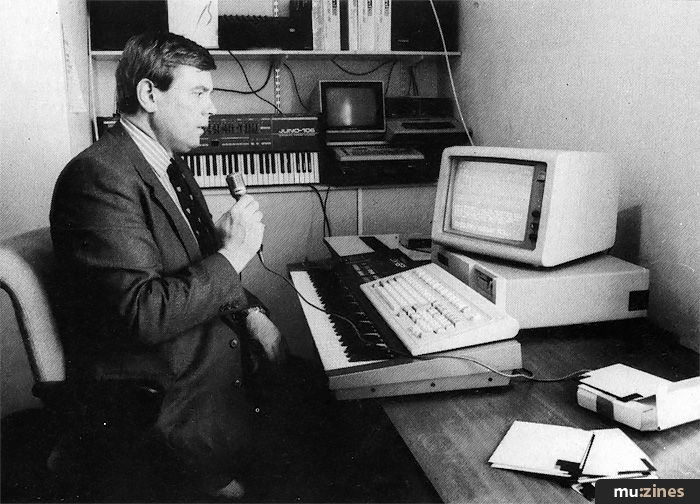
Singing tuition: hit a bum note, and MUSICOM will tell you what you're doing wrong and how to improve things.
Xanadu Innovative products of Jerusalem have recently developed MUSICOM as a computer aided teaching system for teaching music both in schools and in the home. The system is to be marketed by ROLAND (UK) and a series of promotional demonstrations will be presented to the music teaching profession over the coming academic year.
ROLAND'S entry into the academic world is not entirely new, but here for the first time the company will be presenting a highly sophisticated teaching system which can utilise Roland MIDI Keyboards including, in the more advanced lessons, the new 'dynamic touch response' instruments and the RD1000 Digital Piano.
MUSICOM claims that through the use of the computer, the pupil, whether adult or child, will be able to progress at his or her own pace to acquire and develop musical skills. At present the hardware required to operate the system is the IBM PC, (or XT or AT) or fully IBM compatible machine with at least 128K memory and a colour monitor; the MUSICOM interface card and Sony ECM220 microphone, a MIDI-compatible music keyboard and the Roland MPU401 MIDI interface. At present, Xanadu are giving priority to the development of their software programs for the Nimbus machine from RML as this is appearing in increasing numbers in schools.
The MUSICOM Library of diskettes currently available contains the following courses: Ear Training Through Vocal Approach, Fundamentals of Keyboard, A Music Theory course, beginning Rapid Piano Course, and Jazz/Rock for the Keyboard. It is envisaged that this library will continue to develop and will be a comprehensive series covering a wide range of musical studies from complete beginner level to more advanced techniques.
Teaching approach is clean and precise and allows the student to advance at his own pace, with exercises and practice methods built into the programs. These also allow for the choice of level of ability so that the student can progress steadily without being discouraged. Students can repeat pages as they need and revise any previous part of a lesson while the exercises give scores to monitor progress and results can be printed out.
Colour graphics are exceptional – clean and attractive and not without imagination, particularly in the demonstration of notation and rhythm.
The Pitch Rhythm Detector (PRD) is unique in that it displays on the screen not only the accurate pitch of notes played and sung, but will also give accurate rhythms and new developments guarantee that the response is fast.
Indeed, to quote from the information about the Jazz/Rock Course, MUSICOM states that 'Rhythm is the primary foundation of all music, and thus Part I of the course begins with a simple and direct presentation of rhythmic styles, with focus on rhythms found in contemporary rock, funk, jazz-rock, jazz-latin and latin music. From the start, the student is encouraged to invent his own rhythmic patterns and see them properly notated on the screen'. MUSICOM can claim to have the first PRD to do this and this is a very important advance in the field of micro-technology in music education. The use of music keyboard, computer keyboard and the PRD ensure a large level of input from the student and is one of the features which makes the whole MUSICOM system attractive.
Whilst being a didactic system in the best sense, it allows the student to discover much for themselves and to be encouraged and helped along by the computer. Of course, the computer with its infinite patience is ideal for the repetitive nature of some music teaching – the practising of aural tests, reading exercises and rhythmic playing. The system demands accuracy but encourages students in a friendly fashion in its text which is printed clearly and, as with all the graphics, placed in different colours on the monitor to be easy on the eyes. The text and graphics are designed to be attractive and understandable to all ages, not just the student in the classroom, and indeed MUSICOM is ideal for the adult beginner who wishes to work at home. It is an ideal answer for those who say, 'How I wish I had learnt to play when I was young', MUSICOM makes home learning not only possible but successful. MUSICOM is an aid to the teacher by helping in a careful and comprehensive way instruction given in a lesson and by allowing the student to practise and advance at their own pace.
Each set of Diskettes is accompanied by a handbook and these are impressive complements to the teaching programmes. The technical language, both in the books and in the screen text, has been re-written for the UK ie crotchets instead of quarter notes and so on.
MUSICOM is a highly sophisticated teaching aid for music through the computer. Anyone who would like to have more information about the system or to attend a demonstration of it, should contact: Alistair Jones, Roland (UK) Ltd, (Contact Details).
More from these topics
 Mass Storage Technology |
 Amiga Notes |
 Software Support - Hints, Tips & News From The World Of Music Software |
 Amiga Notes |
 Lab Notes: In Pursuit of the Wild QuASH |
Step by Step |
 Software Support - Hints, Tips & News From The World Of Music Software |
ST Notes |
Software Support - Hints, Tips & News From The World of Music Software |
 PC Notes |
Software Support - Hints, Tips & News From The World Of Music Software |
 Digital Signal Processing - An introduction (Part 1) |
Browse by Topic:
Advertisement Feature
Computing
Education
Publisher: International Musician & Recording World - Cover Publications Ltd, Northern & Shell Ltd.
The current copyright owner/s of this content may differ from the originally published copyright notice.
More details on copyright ownership...

International Musician - Jun 1986
Roland Newslink - Summer 86
Feature
Help Support The Things You Love
mu:zines is the result of thousands of hours of effort, and will require many thousands more going forward to reach our goals of getting all this content online.
If you value this resource, you can support this project - it really helps!
Donations for June 2026
Issues donated this month: 0
New issues that have been donated or scanned for us this month.
Funds donated this month: £0.00
All donations and support are gratefully appreciated - thank you.
Magazines Needed - Can You Help?
Do you have any of these magazine issues?
If so, and you can donate, lend or scan them to help complete our archive, please get in touch via the Contribute page - thanks!
Please Contribute to mu:zines by supplying magazines, scanning or donating funds. Thanks!
Monetary donations go towards site running costs, and the occasional coffee for me if there's anything left over!

 @mu_zines
 RSS Feed
 Blog
Blog