


Magazine Archive
Home -> Magazines -> Issues -> Articles in this issue -> View
Winter 1992 NAMM Show Report | |
Article from Sound On Sound, March 1992 | |
NAMM veteran Craig Anderton with news from the biggest and best music show in the US.
So many products, so little time, so few pages! So without further ado, let's review the highlights of the Winter 1992 National Association of Music Merchants convention held in Anaheim, California — the home of Disneyland. In fact, those going into the convention could be forgiven if they thought they entered Disneyland by mistake: roaming around the halls of NAMM, you could easily have thought you were in Tomorrowland or Fantasyland.
KEYBOARDS, DRUM MACHINES, GUITAR SYNTHS
The big news: Alesis announced plans to enter the keyboard market with the S4 QuadraSynth Sound Module (projected US price $995), a 64-voice, rackmount tone generator, and the S5 QuadraSynth Master Keyboard ($1,495), which adds a 76-note keyboard with pressure, velocity, and release velocity. Up to seven simultaneous effects can feed any of four effect busses, and in 'mix mode' (for multi-timbral sequencing applications) each sound can be assigned to discrete effects. Both units include optical digital outputs. The catch is that the units aren't available yet, and won't be until at least the end of the year.
Korg showed the latest additions to their 01 series: the 01R/W, a rack version of the 01/W keyboard including sequencer; 03R/W, a 1U sound module; 01/W Pro, an 01/W with 76-note keyboard, and the 01/W Pro-X, an 01/W with 88-note keyboard. Both Pro models feature new piano and drum sounds and SMF compatibility.
Peavey's DPM2si, a 76-key version of the DPM2, offers twice the sample memory, 32-voice polyphony, and an 80,000 note/96ppqn sequencer. The Spectrum Bass tone module has 1 MB of bass sounds, and is intended to partner Peavey's new MIDI bass guitar. The Spectrum Synth (only $299.99) provides analogue synth sounds with 12-voice polyphony, hard sync, and pulse width modulation. Two upgrades were announced: an 80,000 note, 96ppqn sequencer for the DPM2, and DPM3SE operating system 3.0, that adds loopable envelopes and several other features.
Roland's JV80 Multi-Timbral Synthesizer has 4MB of onboard samples, an optional 8MB expansion board, and 2MB sample expansion cards — up to 14MB of on-board sounds in total. There are eight sliders (a la JD800) for programming or external MIDI control. The JV30 is a junior version with 24 voices, General MIDI standard compatibility, 317 waves, and three assignable data sliders. The General MIDI-compatible JW50 Music Workstation resembles the JV30 but includes a 16-track sequencer with 25,000 note memory, 3.5" disk drive, and eight programmable sliders.
New master keyboards included Roland's A30 (a 76-note weighted controller optimised for use with GS-compatible products), Akai's MX1000 MIDI Master Keyboard (with 76-key piano touch keyboard, six velocity curves, aftertouch, and four independent MIDI outputs), and Peavey's DPM C8 (88-key weighted piano action MIDI controller with four programmable sliders, four independent MIDI outs, and 3.5" MS-DOS disk drive).
On to drum machines; Roland's R70 Human Rhythm Composer drum machine provides 210 instrument sounds, tape sync, and an 'expert system' for assistance in generating patterns. The lower-end Boss DR660 offers 255 instruments. Both have velocity-sensitive pads with aftertouch and built-in digital signal processing.

Yamaha's new TG100 General MIDI module.
Yamaha introduced their first General MIDI-compatible module in the form of the TG100, a 16-part multi-timbral 28-note poly AWM tone generator. On-board digital effects are included. Also new was the RY10 drum machine, boasting 250 AWM sounds, 50 preset patterns and 50 fills, plus the same number of user equivalents, 16 preset and 16 user pad banks, and a line-in jack for guitarists and bassists to plug into.
The biggest news in guitar synthesizers was Roland's GR1, which has excellent tracking (I tried it), good sounds, easy programmability, and an on-board sequencer. Zeta now offer a lower-priced guitar for their fret-wired/pitch-to-MIDI Mirror system, lowering the price to; and the ultrasonic-based Quantar Fretboard Controller still offers superb tracking technology.
An alternative controller, the Starr Datapump, uses switches built into a guitar-like neck to trigger MIDI notes. The right hand plays numerous pressure and touch sensitive pads to provide triggering, pitch bending, level changes, panning, modulation, etc.
SOFTWARE
Notation is the latest 'must'. Oktal's Multitude 2.0 ('Jr.' version $195; without notation $395, with notation $595; Atari ST or TT/IBM/Mac) is a fully-featured sequencer with 256 tracks, drum window, 32 levels of undo, discontiguous selection, Fostex R8 control, and integration of digital audio samples with the Atari Mega STe or TT.
Dr. T's QuickScore Deluxe (IBM PC or compatible) is a fast, simple notation program (up to 16 tracks) that records notes in step or real time and reads/writes SMFs. Passport's MusicTime (Mac and IBM Windows) is a simple composition/notation program that supports up to six musical staves, imports $MFs, and is compatible with Multimedia PC specifications and The Miracle Keyboard for the PC.
Moving up the price ladder, Mark of the Unicorn's Mosaic (Macintosh) boasts sophisticated page layout features, lyrics, multi-level undo, over 160 musical symbols, and SMF compatibility; Opcode also announced a new notation program.
Speaking of Opcode, the Studio AV is a 1U rack video deck transport controller for all major video decks. Features include VITC read/write, character generator, and audio deck control. An expander, the Studio AVx, is available to control additional decks. Mark of the Unicorn also branched into hardware with the Waveboard, a Mac II/Quadra NuBus card that, in conjunction with MOTU's Digital Performer software and outboard AES/EBU or SPDIF A/D-D/A convertors, provides direct-to-disk, random access 16-bit digital recording.
Atari made quite a comeback. The STbook notebook computer weighs less than 4lbs, and offers an internal hard disk, expandable RAM, MIDI ports, and optional internal fax modem. In the Atari software world, Hotz Instruments released a version of their Translator program designed to work with standard keyboards instead of the ultra-expensive Hotz hardware controller. Perhaps more people will now get to check out this intriguing program. CodeHead's clever MIDI Spy ($79.95) records MIDI data in the background so that you won't lose any musical ideas, even if you're working at a non-music program. It can read and write SMFs. WC Music Research's DNA Groove Templates provide 96 groove templates for Steinberg's Cubase sequencer. Check this out if you're tired of overly-quantised music.
Steinberg, C-Lab, and Dr. T's made a joint announcement with Fostex and Atari that their sequencer programs will now support the Fostex R8, G16, and G24S tape recorders, treating them as 'MIDI peripherals'. Transport functions, record enable, and punch-in are all controlled at the sequencer.
The Atari also had some new hard disk audio support. Plasmec's ADAS Stereo Hard Disk Recorder (Atari, Mac, IBM and compatibles) is now available in the US. The optional Digital Board provides SPDIF and AES/EBU formats. Hybrid Arts' Digital Master EX ($2,999; $999 for 2-channel analogue I/O; requires Atari ST and SCSI hard disk) is a 4-channel (expandable to 8 or 12), 16-virtual track, direct-to-disk recorder/editor with SMPTE reader, two 33MHz digital signal processors, and four channels of AES/EBU I/O. Hybrid also showed the Sample Playback Module ($1,399), a 16-bit, 24-voice, 12-output sample player that runs with the Digital Master EX or as a stand-alone unit, and the SCSI Module, a DMS-SCSI convertor that enables the Atari to use standard SCSI drives.
Digidesign continues to rule Mac hard disk recording. The Sound Tools II ($3,495) hard disk recording system supports up to 4-track record and playback with Studio Vision, Digital Performer, Cubase Audio, and Deck 2.0.
Passport's Producer (for Mac and Windows) integrates and sequences digital audio, MIDI sequences, CD audio, QuickTime video, animation, and laser disc. The user interface is based on a cue sheet metaphor, where the various elements are dragged into the sheet and programmed to start at specific times. Another unusual program, Dr. T's Interactor ($279, Macintosh), is a graphics-based programming language, developed with composer Morton Subotnick, that provides a flexible environment for creating interactive and algorithmic pieces.
A more pop-oriented algorithmic package, Soundtrek Jammer (IBM PC and compatibles) creates credible drum/bass/rhythm (chord, strum, arpeggio, etc.) accompaniment. Also for the IBM, Twelve Tone Systems now has Cakewalk Professional for Windows, which allows for insertion of Media Control Interface commands to control multimedia devices such as CD-ROM players, sound cards, VCRs, etc.
Need noises from your PC? Plug in the Roland SCC1 GS Sound Card, with 317 instruments, nine drum sets, and sound effects. It's General MIDI/MPC/MT32/LAPC1 compatible, and boasts 24-voice polyphony.
Instrument-specific software was not too common, but Sound Quest now offer individual editor/librarians (Amiga, Atari, IBM, IBM Windows, and Mac) derived from their universal editor/librarian. Interval Music Systems' EDIT (Macintosh) is a front panel editor for Akai S1000/S1100 samplers that's System 7 compatible; and Sweetwater Sound's K2000 Diskmaker (Mac) reads sounds in Kurzweil 250, SampleCell, or Sound Designer formats and converts them to (Kurzweil) K2000 disk format.

Tascam MM200 keyboard mixer: eight stereo inputs and BBC circuitry.
MIXERS
According to the Chinese calendar, 1992 is the Year of the Mixer. The Alesis X2 Recording Console ($5,995) offers 24 channels, 24 tape monitor ins, and 16 returns (all available simultaneously for 64-input operation). Mackie's 8-Buss Mixing Consoles (16X8, 24X8, 32X8) use in-line monitoring to double the number of inputs for mixdown.
ART's Phantom series includes three versions: 1608, 2408 and 3208. All include 3-band EQ and clip indicator for all channels, steel chassis, patch points, XLR balanced mic inputs, and direct outputs.
DOD's 16-channel 1642 includes 3-band EQ and 1/4" insert point for each channel. For line mixer applications, there's the 822 8-Channel Mixer and 1222 12-Channel Mixer. The Roland Ml6011 Line Mixer offers 16 line level inputs in a 4U rack space. The Rolls Corporation RM81 MixMax is a basic 8-channel mixer with eight XLR mic inputs and eight 1/4" line inputs, volume, and tone controls.
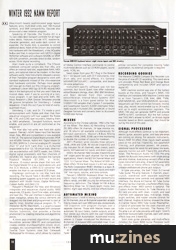
Tascam's MM200 Keyboard Mixer has eight stereo input channels, switchable stereo/mono effects sends, and BBE circuitry for enhanced high frequency definition. The Model Ml08 4-Buss Recording Mixer has 12 inputs (eight mono, two stereo), eight tape returns, and two effects busses.
AUTOMATED MIXING
AUDIOmation's MX816 Mixing Automation (eight or 16 channels, plus an 8-channel expander) accepts mixing moves sent over MIDI and also stores/recalls 100 snapshots with program changes over a separate channel. Those with Mackie mixers can automate 16 input faders, master outputs, and all four stereo aux returns with the user-installable CR1604 Add-On Automation. Automated mixing veteran JL Cooper introduced the MixMaster, an 8-channel, VCA-based MIDI-controlled mixer. It can patch into insert points or serve as a stand-alone 8x1 or 4x2 automated line mixer.
At the high end, Tascam's M7/MFA Moving Fader Package ($50,000) retrofits the M700 (or similar consoles) for complete moving fader automation; no external computer is required.
RECORDING GOODIES
The Marantz CDR600 Compact Disc Recorder cuts the price of one-off CD recording. This stand-alone unit provides Philips Red Book and Orange Book compatibility and includes SPDIF and optical digital I/O.
MIDI machine control was one of the hottest buzzes at the show, and Tascam's MMC-100 Interface Unit translates MIDI Machine Control data to or from Tascam's 238, 644, 688, TSR8, MSR16/MSR16S, and MSR24/MSR24S recorders. Sequencers can then control fast forward, rewind, stop, play, record, record enable (up to 24 tracks), and up to eight autolocation registers. The MMC-100 also can generate SMPTE and provide SMPTE-to-MTC conversion. But the hot rumour was TASCAM's answer to ADAT, an 8-track digital recorder based on 8mm cassettes, that should be out by the end of this year.
SIGNAL PROCESSORS
Although multi-effects continue to be important, electric guitar, acoustic guitar, and bass pre-amps are coming on strong. For acoustic instruments, Rane's MAP 33 offers three inputs (each accepts piezo or mic and has 7-band EQ, low pass/notch filtering, and phantom power), 64 presets, additional Inputs for vocal mic and stereo line levels, separate monitor out with 7-band EQ, and effects loops. The Pendulum Audio HZ-10SE Pre-amp System for Acoustic Instruments (with single pickup pre-amp module, dual pickup version) offers a low noise instrument pre-amp, 4-band full parametric EQ, stereo or mono effects interfacing, and unbalanced/balanced phone jack outputs.
In tube pre-amps, the Exef Triton 3-Channel Tube Guitar Pre-amp features 3 channels (clean, crunch, overdrive) with separate bass/mid/treble/presence tone controls and optional MIDI interface; the 4tune 4-Channel All Tube Guitar Pre-amp has four channels, a buffered effects loop, and effects mixer. MIDI control is optional. The Custom Audio Electronics 3+ Tube Pre-amp is a 3U rack pre-amp with clean, crunch, and lead channels with separate bass, mid-range, treble, bright switches, and master volume controls for each channel. Hughes & Kettner showed the Attax 3-Channel Stereo MIDI Tube Guitar Preamplifier, a hybrid of solid-state (for the clean channel) and tube crunch/lead channels. The Peavey PT3 Pre-amp is an all tube pre-amp with eight 12AX7s and three footswitchable channels, each with stereo effects loop and 3-band EQ.
Solid state guitar pre-amps and multi-effects included the Zoom 9000 Guitar Processor (with free FC01 remote foot controller) with 21 programmable effects and a mix input for playing along with CD/tape/line level instruments. The SansAmp Rack is a rack version of the standard SansAmp but replaces the former's DIP switches with continuously variable controls and more advanced input/output options. Peavey's Pro-Fex II has up to eight effects, which you can arrange in series or parallel, programmable/movable effects loop, RAM card slot, dual pitch shifters, and real-time MIDI parameter control.
The Boss ME-10 Guitar Multiple Effects user interface has one membrane switch for each function, and a parameter value knob. Punch up the parameter to be changed, and change it with the dial — no menus, no LCD, no scrolling. DigiTech combined multi-effects and pre-amp functions in a floor package with integral MIDI footswitch; the RP1 Guitar Multi-effector/Footswitch features steel chassis and 23 different effects (up to 10 available simultaneously). Also, the GSP21 Legend ($799.95) improves on the GSP21 Pro with new 'celebrity presets', redesigned speaker simulator, and digital delay modulation.
Bass pre-amp standouts included the Ampeg SVT-IIP, an all tube rack pre-amp with three bands of EQ and 6-band graphic EQ; Scholz R&D Pro Bass Rockman with compression, 9-band graphic EQ, and footswitchable chorus, overdrive, biamp crossover, and bass/mid/treble EQ; Gallien-Krueger 100MPB with dual EQ sections, stereo chorus, compressor, switchable mono effects loop, mono/stereo/bi-amp with variable crossover outputs; and the Peavey Bass-Fex, a bass version of Pro-Fex II with chain split option for bi-amping.
BBE introduced pre-amps for guitar (BBE 381), bass (BBE 383), and acoustic guitar (BBE 386). All three models include BBE processing. BBE also showed the 122-SNR Spectral Noise Reduction , a single-ended 2-channel noise reduction system with adjustable noise reduction frequency.
ART introduced the SGX-T2 multi-effects with 70 different effects (up to 12 are available simultaneously). The SGX-LT is a very cost-effective multi-effects with multiple knobs for easy programming; control settings are remembered automatically for each of the 200 patches. Effects include reverb, chorus, flange, delay, etc. The MultiVerb LTX is a studio processor with over 250 non-editable presets and MIDI patch mapping. Finally, the DR-X 2100 is a studio version of the SGX-T2 without speaker simulator and distortion, but with other effects such as harmonic exciter and digital crossover.
Higher end signal processors included; the Drawmer DL251 Spectral Compressor, which simulates the action of a two-band compressor; Behringer XR2000 Intelligate , a rack dual mono/stereo gate/expander/ducker; Rocktron Intelliverb , a version of the Intellifex optimised for reverb (it also offers chorus, delay, pitch shifting, etc.). Yamaha's DEQ5 Digital Equaliser functions as a dual-channel, 1/3-octave graphic equaliser or 6-band parametric and also provides 1300ms of delay and hum canceller. The DEQ5E expansion unit provides the same feature set but without front-panel programming controls or displays. TC Electronic showed the very interesting M5000 Digital Audio Mainframe, a modular stereo signal processor-featuring an expandable 24-bit bus that supports up to four expansion modules. Expansion allows for custom configurations for recording, broadcast, and sound reinforcement applications.
MISCELLANEOUS
New MIDI footswitches: the Rolls MP1288 MIDI Wizard 12-switch footswitch sends program change commands and up to eight channels of controller data from analogue sources (eg. footpedals or 0-5V control voltage). DigiTech's PMC 10 MIDI Foot Controller stores 500 patches, 99 banks, and five sets; it includes two continuous controller inputs and can send SysEx, note, pitch bend, key/channel pressure, and MIDI mode change data.
For miking guitar amps with minimum leakage and noise, the Demeter Amplification Silent Speaker Chamber is a completely sealed speaker cabinet (speakers and mics not included).
The JL Cooper Electronics DataSYNC generates MIDI Time Code directly from the Alesis ADAT 9-pin sync connector, thus eliminating the need to stripe a track with SMPTE. It also converts ADAT's transport functions into MIDI Machine Control messages. The Media Control Station is a hardware interface with tape transport-style controls and jog/shuttle wheel for controlling MIDI sequencers (includes presets for Performer and Vision).
Marion Systems Corporation's MPC-SCSI hard disk interface for the Akai MPC60 and MPC60-II can use most Mac-compatible hard disks to let the MPC-60 store up to 780MB; installation takes 10 minutes and a screwdriver.
The Akai ME35T for acoustic and electronic drum pads converts up to eight audio signals into MIDI triggers. The ME80P MIDI programmable patch bay has eight inputs and ten outputs, stores 128 patch programs, and includes MIDI merging.
Peavey's PC1600 MIDI Controller offers 16 programmable sliders, 16 programmable switches, two programmable CV inputs, and data wheel for sequencer mixing, remote editing, etc.
Of course, there was more — but that's all we have space for here.
Publisher: Sound On Sound - SOS Publications Ltd.
The contents of this magazine are re-published here with the kind permission of SOS Publications Ltd.
The current copyright owner/s of this content may differ from the originally published copyright notice.
More details on copyright ownership...

Sound On Sound - Mar 1992
Show Report by Craig Anderton
Help Support The Things You Love
mu:zines is the result of thousands of hours of effort, and will require many thousands more going forward to reach our goals of getting all this content online.
If you value this resource, you can support this project - it really helps!
Donations for October 2026
Issues donated this month: 0
New issues that have been donated or scanned for us this month.
Funds donated this month: £0.00
All donations and support are gratefully appreciated - thank you.
Magazines Needed - Can You Help?
Do you have any of these magazine issues?
If so, and you can donate, lend or scan them to help complete our archive, please get in touch via the Contribute page - thanks!
If you're enjoying the site, please consider supporting me to help build this archive...
...with a one time Donation, or a recurring Donation of just £2 a month. It really helps - thank you!

 @mu_zines
 RSS Feed
 Blog
Blog