


Magazine Archive
Home -> Magazines -> Issues -> Articles in this issue -> View
Vintage Synthesizers | |
Edited by Mark Vail, Miller Freeman BooksArticle from Music Technology, October 1993 | |
Vintage Synthesizers edited by Mark Vail. An American book celebrating the classics

If you're interested in old synths buy this book. It's by no means a complete rundown of every vintage synth ever made; it's not logically planned; some of the black and white pictures are rather murky - but it's absolutely fascinating.
I should point out that if you happen to have been a subscriber to the American magazine Keyboard over the last ten years or so, you'll have seen nearly all of this book before: it's largely composed of straight reprints of articles from the magazine. But if not, you're in for a treat. In addition to contributions from Bob Moog on the rise and fall of ARP and Moog, the book features his evaluation of the ARP 2600, the Oberheim SEM module, the Minimoog and E-mu modular synths. Moog also pays respectful homage to some of the other all-time great machines, like the Prophet 5, the VCS3/Synthi AKS, the CS80 and the Chroma, and some specifically American detail on Buchla and EML which is hard to come by on this side of the Atlantic.
A further section is dedicated to classic digital synths like the PPG Wave, Synergy, GDS, Fairlight and Emulator, and there's a rundown of some of the best European analogue designs, like the Kobol, the Syrinx, the Wasp, the OSCar and, of course, the Mellotron in all its tape-driven glory.
But it's not only the success stories that are covered. The book offers due reverential regard to the almost unknowns, the brave failures and the chronic disasters that litter the history of synthesis: the Coupland (like something out of Invasion Of The Bodysnatchers); the Con Brio (which went through three incarnations and sold one unit for $30,000); the Kinetic Sound Prism (which also clocked up sales of one unit, this time for $45,000); and other expensive toys like the McLeyvier and Adaptive Systems' Synthia.
And it's not all top-end turkeys either. You could spend a lot less money and still end up with complete off-the-wall oddness - like the Vako Orchestron, the Gleeman Pentaphonic Clear and, of course, the Stylophone. The strange thing is that even if instruments like this don't sound that great, they do, at least, sound different. They have character, nostalgic appeal and just plain weirdness, and often appreciate more than the solid, useful workhorses. A few years ago, there were hardly any takers for combo organs, even at bargain prices. Suddenly, as a chapter in the book reveals, they've become desirable and collectable.
Vintage Synthesizers includes a price guide for many classic machines (prices, you will note, are much lower in the States) and this throws up some anomalies such as DX5s being cheaper on the street than DX7s, and Vox Jaguars more expensive than Continentals. It also includes tantalising references to keyboards I never knew existed, such as the Roland VP220, the Sequential Split-8 and the Minitmoog (sic) - a misprint or a rarity? The great thing about this book is that it makes you want to find out.
THE LAST WORD
| Usefulness | Invaluable for the enthusiast |
| Value for money | Peanuts - if you enjoy 'A-Z Of Analogue' |
| Star Quality | Content triumphs over style |
| Price | £15.99 |
| More from | Gazelle Book Services, (Contact Details) |
Publisher: Music Technology - Music Maker Publications (UK), Future Publishing.
The current copyright owner/s of this content may differ from the originally published copyright notice.
More details on copyright ownership...
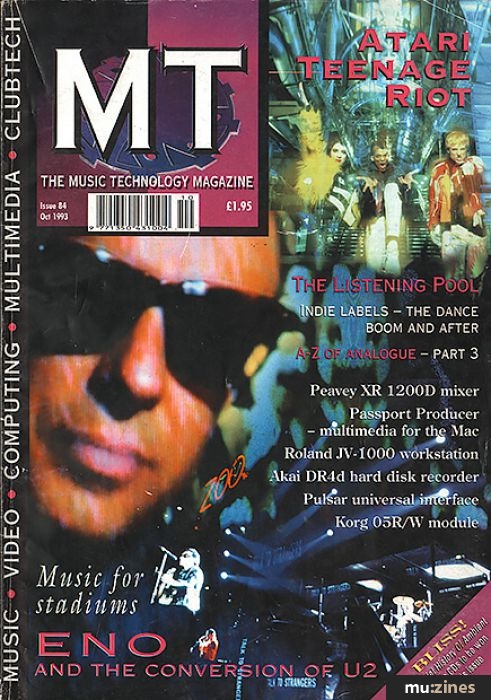
Music Technology - Oct 1993
Donated by: Ian Sanderson
Review by Peter Forrest
Help Support The Things You Love
mu:zines is the result of thousands of hours of effort, and will require many thousands more going forward to reach our goals of getting all this content online.
If you value this resource, you can support this project - it really helps!
Donations for April 2026
Issues donated this month: 0
New issues that have been donated or scanned for us this month.
Funds donated this month: £0.00
All donations and support are gratefully appreciated - thank you.
Magazines Needed - Can You Help?
Do you have any of these magazine issues?
If so, and you can donate, lend or scan them to help complete our archive, please get in touch via the Contribute page - thanks!
If you're enjoying the site, please consider supporting me to help build this archive...
...with a one time Donation, or a recurring Donation of just £2 a month. It really helps - thank you!

 @mu_zines
 RSS Feed
 Blog
Blog