


Magazine Archive
Home -> Magazines -> Issues -> Articles in this issue -> View
Thunder Enlightening | |
The Fabulous ThunderbirdsArticle from Making Music, January 1987 | |
You gotta crib to get better, so say Texan types Kim Wilson and Jimmie Vaughan
The Fabulous Thunderbirds come from Texas. Jon Lewin comes from Cambridge. And happiness comes from copying people. Read on and understand.
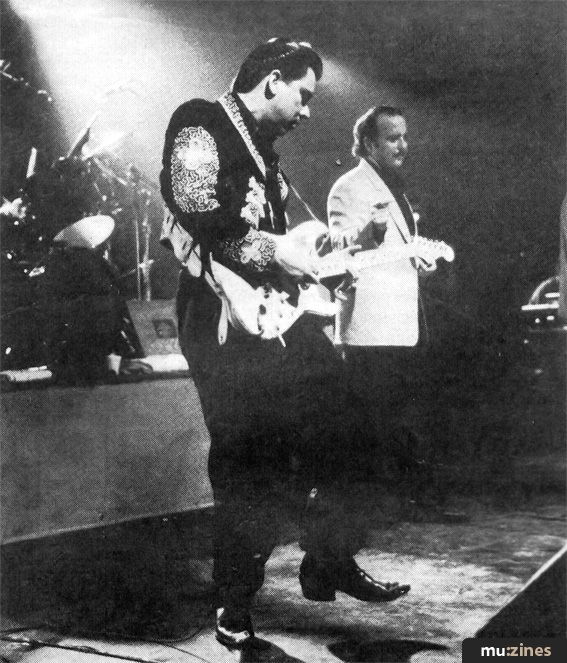
KIM WILSON and Jimmie Vaughan have been playing together in the Fabulous Thunderbirds for 13 years. "Tuff Enuff", their fifth and most recent album has sold 900,000 copies in the US. Eric Clapton has referred to Jimmie as one of the great guitarists; Robert Cray picked Jimmie as his favourite musician. American magazine Guitar Player described Kim as the finest harmonica player of his generation.
How come?
"You've got to have a direction," says Jimmie, "but you've got to learn from a lot of people you've got to steal something, or you've got nothing to start with. Play whatever turns you on musically — just copy those guys until you get tired of it, then you'll start doing something of your own."
The Fabulous Thunderbirds are a rhythm'n'blues band. They come from the American tradition of bar bands, groups who make a living playing small clubs and bars — the Yankee equivalent of pub rock.
Jimmie was already a guitar hero at the age of 15, playing around Dallas in a band called The Chessman, who even supported Jimi Hendrix when he played in Dallas in 1967.
"Hendrix broke his wah wah, or somebody stole it, and I had the kind he wanted, so he gave me $50, and a shitty one he didn't like, and he took mine — it was a Vox. My brother [Stevie Ray Vaughan] uses it now — he got it back."
Kim came down South from Chicago, the other great home of electric blues. His harp heroes include people like little Walter, George Smith, James Cotton, Big Walter Horton, and both Sonny Boy Williamsons.
"I learnt a lot from guitar players too, like Wilf Wilson, Albert Collins, Eddie Taylor. But Muddy Waters is the biggest influence for everything on me."
Now the Fabulous Thunderbirds are based in Austin, Texas, though they spend most of their time touring — they've had one month off since last October. Jimmie thinks that his being Texan is important, and admits to being heavily influenced by southern blues and R&B.
"I listened to all those great guitar players from Texas — T-Bone Walker, Lightning Hopkins, B. B. King, Albert King, Albert Collins, Eddie Taylor who played on Jimmy Reed's records, Muddy Waters..."
With the Chessmen Jimmie was playing Hendrix/Cream style rock — it wasn't until he saw Muddy Waters playing live in 1968 that he began exploring the clipped, understated blues style that is now his trademark. Jimmie put his first full-blooded blues band — Storm — together in 1970 when he moved to Austin.
"If you're doing what you don't want to, it's really a drag," Jimmie advises. "Just play what you like, play what you want to hear, don't pay attention to what anybody else says..."
Playing with other musicians has obviously been an important part of Jimmie and Kim's musical education. This seems to be more a part of the US tradition, not something so popular in Britain these days. But how do you go about finding other people to play with?
"Just go to the local music store and hang around, go and see bands, talk to the people you think are good, get together, play a bit."
Something else that could be attributed to the Thunderbirds' American background is their attitude to audiences. Kim?
"You are playing for an audience, and if they don't like it, there's no sense in you being up there. But you've gotta like it too — if you don't like it, how are they supposed to like it?"
Jimmie is a little more introspective.
"I please myself first, but I try to do it so they like it at the same time. But if my amp sounds good, I'm gonna have a good time."
The final question is asked with some trepidation — what happens when they get bored with 12 bars? Kim laughs. "We just go to no changes."
On Stage
"I might have an extra amp. I plug in the back of my echo, and that goes into my amps. It isn't stereo. Or it might be. I dunno, it's really basic. I only have two amps so I can turn my volume down and get a good tone without having to crank it up real loud, and use the monitor. I use a really basic stock guitar/amp set up, and the echo is an ADA TFX4.
"As for guitars... all that vintage crap doesn't mean anything to me — they made good ones and bad ones then just like they do now. I'd rather spend the money on my shoes. I've got 15 or 20 guitars, but I don't spend a lot of money on them. They're just boat paddles. People give them to me, too: Santana gave me one, and Billy Gibbons gave me one; my brother's given me several. When I stopped caring about it, people started giving me things."
Publisher: Making Music - Track Record Publishing Ltd, Nexus Media Ltd.
The current copyright owner/s of this content may differ from the originally published copyright notice.
More details on copyright ownership...

Making Music - Jan 1987
Interview by Jon Lewin
Help Support The Things You Love
mu:zines is the result of thousands of hours of effort, and will require many thousands more going forward to reach our goals of getting all this content online.
If you value this resource, you can support this project - it really helps!
Donations for June 2026
Issues donated this month: 0
New issues that have been donated or scanned for us this month.
Funds donated this month: £0.00
All donations and support are gratefully appreciated - thank you.
Magazines Needed - Can You Help?
Do you have any of these magazine issues?
If so, and you can donate, lend or scan them to help complete our archive, please get in touch via the Contribute page - thanks!
If you're enjoying the site, please consider supporting me to help build this archive...
...with a one time Donation, or a recurring Donation of just £2 a month. It really helps - thank you!

 @mu_zines
 RSS Feed
 Blog
Blog