


Magazine Archive
Home -> Magazines -> Issues -> Articles in this issue -> View
Novation MM10 | |
Portable MIDI Keyboard ControllerArticle from Music Technology, August 1992 | |
It makes no sound, but it makes a lot of sense.
Although aimed at Yamaha QY10 users, Novation's two-octave MIDI keyboard should suit any musician who needs a cheap, lightweight MIDI controller - to go.

'PORTABLE' would normally be the last word you'd use to describe a MIDI controller keyboard (No... I think it would be 'interesting' - Ed). Ever since Roland and Yamaha introduced musicians to the concept of the silent keyboard instrument with their MKB1000 and KX88 88-note weighted keyboard controllers back in the mid-eighties, the MIDI controller keyboard has primarily been seen as an instrument for professional keyboard players to use both live and in the studio. Hence the emphasis on high-class keyboard actions and 'solid' build quality.
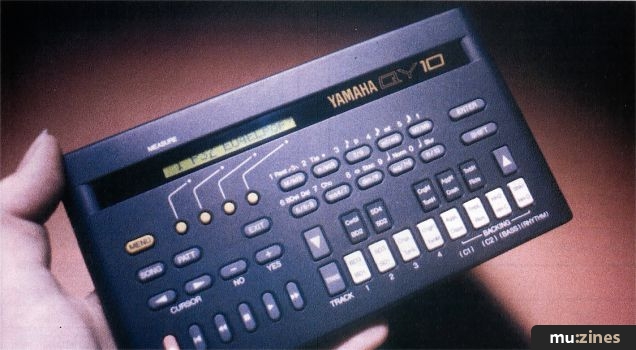
Yet increasingly there has been a need for a small, lightweight MIDI controller keyboard to go with the new generation of er, small, lightweight sound-generating modules coming onto the market. Yamaha's best-selling QY10 'walkstation' is a case in point. Here you have an instrument which provides an eight-track sequencer, a multitimbral sound source and a drum machine in a cabinet roughly the size of a VHS video cassette.
Owners of this neat little box of tricks, after gaping in wonderment at the triumph of miniaturisation, then have to get used to recording music into it by tapping away on a small monophonic 'keyboard' consisting of 12 rubber buttons. Not a lot of fun. Fortunately, you can also record into the QY10 from an external MIDI source, which is where Novation and their two-octave MM10 MIDI controller keyboard come in.
First of all, some vital statistics: the MM10 measures 18" x 8" x 2" and weighs just 3.5lbs with batteries fitted - so it easily qualifies as portable. The batteries required, incidentally, are six AA types, which give some 40 hours out-in-a-field-in-the-middle-of-nowhere playing time. When there are around five hours of battery time left, the power on/off LED will start blinking at you fairly rapidly, and as the power gets lower, the rate of blinking will get slower - a helpfully constant reminder that you need to think about buying some more batteries.
If you happen to be near a mains supply, you can power the MM10 via an external adaptor (not supplied with the machine). This should be a 9V regulated, centre positive psu rated at 300mA. Novation market their own PSU1 unit at £16.95, which may seem like a lot of money, but with cheaper unregulated adaptors you get a loud hum on the MM10's audio output which you just won't want to live with.
But hey, hang on a minute, why on earth would a silent controller keyboard need an audio output? Well, here we come to the QY10 connection - or rather, one of the QY10 connections. Turning to the MM10's rear panel for the moment, we find in addition to the expected power on/off switch, 9v DC power input and MIDI Out socket a second power connection, a mini-jack line in and two mini-jack audio outputs. Using three leads which come supplied with the MM10 (sheathed together for convenience), you can make audio, MIDI and power connections between the keyboard and a QY10. The audio lead allows you to feed the QY's audio output into the MM10, where it's boosted by two 1 watt stereo amplifiers before being transmitted via the two audio outs, into which you can plug a couple of pairs of headphones, a pair of powered speakers, or audio leads to a mixer.
The value of this is that output level via the MM10 is much improved over that from the QY10's own headphone amplifier - an important consideration if you're using your QY in noisy surroundings. On the down side, the amplified output is noisier because, of course, background noise in the QY10's signal gets amplified along with everything else. However, as you only need to use the MM10's output when surrounding noise levels require a louder signal than the QY can deliver, you probably won't notice the increase in noise.
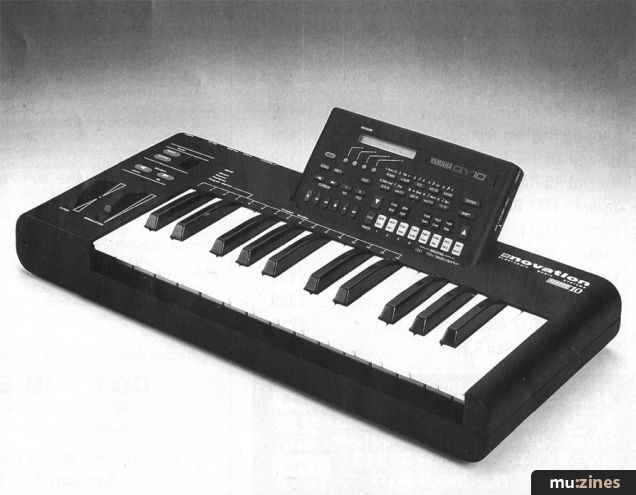
The MIDI connection allows you to play the QY10's sounds, and to record parts into its sequencer memory in both real- and step-time, from the MM10's two-octave, velocity-sensitive keyboard. This has full-size keys and a comfortable synth-style action, and, of course, allows you to play polyphonically. Using a MIDI keyboard (as opposed to the QY10's rubber buttons) really helps you to get the most out of the little marvel. Using the MM10's MIDI keyboard ensures that you don't lose the 'walk' in 'walkstation' as a result.
The third connection between MM10 and QY10 allows you to take a power feed from the keyboard into the QY10, though this will only function if you're powering the MM10 from the mains. If you're running the keyboard off batteries, the QY10 must be battery-powered as well, which means you need a total of 12 AA batteries for portable use.
In further pursuit of QY-friendliness, Novation have provided a slot on the MM10's front panel into which the QY10 sits quite comfortably, facing towards you at about a 45-degree angle. However, you can't lock the QY into the slot, and it does tend to move around a bit when you're jabbing away at its buttons. Some Blu-Tack will hold it firmly in place, but doesn't have the adhesive power to guarantee that it will stay there should you turn the MM10 on its side or upside down.

So, you have your MM10, your QY10, the necessary connecting leads and a pair of headphones and you're ready to head out into the countryside for a spot of musical communing with nature. But how are you going to carry the gear around with you? Well, Novation are marketing a soft carry case for the MM10 which comes complete with a shoulder strap and a zipped pouch for the QY10, headphones and leads. A worthwhile investment if you want to protect your assets.
Let's get one thing clear: the MM10 is not going to give you anything close to the MIDI control sophistication found on expensive 88-note MIDI controller keyboards. But then, with a two-octave keyboard and a price tag of £149.99, you'd hardly expect it to. Besides, the MM10's very simplicity is one of its greatest virtues. You can do just four things: change the keyboard octave, change the MIDI channel, transpose the MIDI note output and send a patch change via MIDI.
At the left end of the MM10's front panel are four buttons - Menu, Enter, Select Down and Select Up - and a single-digit LED display. You select the four modes cyclically with successive presses of the Menu button, and use the Select buttons to alter each mode's programmed value. The Enter button is used to confirm a keyboard transposition or return to the default mode (octave shift) immediately after selecting a patch change.
Once you've selected a mode, the LED alternates between showing a letter which indicates what the mode is ('o', 'c', 't' or 'p') and showing the programmed value for that mode. However, if five or six seconds pass by without a button being pressed, the display goes out to conserve battery power, and the MM10 reverts to octave shift mode. This can be a bit annoying at times, not to mention confusing to begin with. However, treating octave shift as the default mode makes sense, because while you're playing you can quickly change the keyboard octave without having to bother about using the Menu button to select the right mode. And turning off the LED display so that less power is consumed also makes sense, because there's simply no need to leave it on all the time.
With the octave shift mode, the MM10's two-octave physical keyboard becomes a 'window' onto a ten-octave virtual keyboard, allowing you to play across the entire MIDI note range. On power-up, the middle C key on the keyboard triggers MIDI note 60 - ie, C3 or middle C; using the Select buttons you can then shift the keyboard up or down four octaves. One neat feature of octave shifting on the MM10 is that if you are holding any notes when you shift the keyboard octave they are unaffected, so you could, for instance, hold a drone note in a low octave, then switch to a higher octave and play another part.
The MM10 defaults to C=C on power-up, but with the transposition mode selected you can use the lower octave of keys to transpose the MIDI output. For instance, if you press the F key, all notes will be transposed up a perfect fourth - so if you're playing in the key of C on the keyboard, your MIDI module will actually be playing notes in the key of F. Once again, held notes are unaffected by any changes.
Novation have got around the problem of selecting three-digit patch numbers from a single-digit LED by confining LED selection to eight banks of 16 patches each, and putting individual patch selection on the bottom 16 keys of the keyboard. This leaves you the top nine keys to play the selected sound from as you're selecting different patches. Helpfully, Novation have printed the numbers 1-16 on the front panel above the relevant keys, but you still have to indulge in a quick spot of arithmetic if you want to select a specific patch number - eg, patch 94 is bank 6, key 14.
Novation's keyboard makes an ideal companion for the QY10, allowing you to get the most out of Yamaha's 'walkstation' without having to sacrifice the practical advantages of a portable, use-anywhere musical setup. At the same time, there's no reason why its use should be limited to controlling the QY10 - after all, the whole idea of a MIDI controller keyboard is that it should allow you to access any MIDI sound source. Plus points, in terms of general performance purposes, are the keyboard's velocity sensitivity and the inclusion of pitchbend and mod wheels. I do feel it's a shame though that no sustain pedal input or volume slider were included.
The MM10's straightforward design and (relative) inexpensiveness also make it a good choice for anyone starting out in MIDI-based music making with a limited budget - depending, obviously, on whether or not its two-octave keyboard span is acceptable. If you do need a wider keyboard, another inexpensive velocity-sensitive, mains or battery powered MIDI controller keyboard worth considering would be Roland's 49-key PC200GS at £205.
For their part, Novation have come up with a fine example of affordable and accessible technology which fulfills a very useful role in the new world of portable hi-tech music making. The MM10 deserves to sell like the proverbial hot cakes.
Prices: MM10 £149.99; CC1 carrying case £16.95, PSU1 power supply £14.95. All prices inclusive of VAT.
More from: Novation Electronic Music Systems Ltd, (Contact Details).
Also featuring gear in this article
Novation MM10 - Portable Midi Master Keyboard
(SOS Jun 92)
Browse category: Keyboard - MIDI/Master > Novation
Featuring related gear
Novation mm10-X - keyboard
(MT Oct 93)

The Power To Be Portable - Yamaha QY10
(SOS May 91)
Yamaha QY10 - Music Sequencer
(MT May 91)
Browse category: Keyboard - MIDI/Master > Novation
Browse category: MIDI Workstation > Yamaha
Publisher: Music Technology - Music Maker Publications (UK), Future Publishing.
The current copyright owner/s of this content may differ from the originally published copyright notice.
More details on copyright ownership...

Music Technology - Aug 1992
Donated by: Mike Gorman, Chris Moore
Scanned by: Mike Gorman
Gear in this article:
Review by Simon Trask
Ads for Gear in this article:


Help Support The Things You Love
mu:zines is the result of thousands of hours of effort, and will require many thousands more going forward to reach our goals of getting all this content online.
If you value this resource, you can support this project - it really helps!
Donations for April 2026
Issues donated this month: 0
New issues that have been donated or scanned for us this month.
Funds donated this month: £0.00
All donations and support are gratefully appreciated - thank you.
Magazines Needed - Can You Help?
Do you have any of these magazine issues?
If so, and you can donate, lend or scan them to help complete our archive, please get in touch via the Contribute page - thanks!
Please Contribute to mu:zines by supplying magazines, scanning or donating funds. Thanks!
Monetary donations go towards site running costs, and the occasional coffee for me if there's anything left over!

 @mu_zines
 RSS Feed
 Blog
Blog