


Magazine Archive
Home -> Magazines -> Issues -> Articles in this issue -> View
Article Group: | |
MTR Dual Noise Gate | |
Studio TestArticle from International Musician & Recording World, July 1986 | |
It's cheap, it's fast, it's sensitive — it's Jim Betteridge

Challenging Drawmer to a serious Dual
The Drawmer dual gate has been a phenomenal success ever since it appeared on the market some years ago. Its main feature was, and is, that it includes an in-built equaliser with which the signal triggering the gate can be modified. MTR, renowned for the cost-effective approach to recording, have brought out what to most intents and purposes is their version of the same. It costs £100 less and has a faster attack time. Is it really the bargain it seems (yes it probably is, just in case you can't be bothered to read the rest of this) or is there still nothing like the original? First a little background concerning the points under discussion:
Adjusting Your Gait — A Brief History
When a signal enters the input of a gate it comes across a 'level conscious switch' that only closes to allow it to pass through to the output if its level is high enough. If, for instance, you played a snare drum in a continuous pattern of three soft hits and one loud one, by setting the switch threshold of the gate above the softer level and below the louder one, you could cut out everything except for the fourth hit of each cycle.
Alternatively, if the gate has a 'key' input, you can have your primary signal connected to the normal input and have a secondary signal connected to the key input triggering the gate action. In this way you might have a source of white noise being keyed by your snare drum, so that with every snare drum beat you get a short burst of white noise.
A further application of the key input is to separate out primary instruments that have been recorded on tape from any crosstalk that might have leaked in during recording. A clear and common example of this is the existence of hi hat on a snare recording. Inexperienced (or bad) drummers tend to lay heavily into the hi hat and only tap the snare making it very difficult, even with close miking, to get an unpolluted recording of the snare on tape. If the levels of the snare and hi hat are comparable, it isn't possible to separate them by simply gating them. Instead it is necessary to split the signal putting one half straight through the normal input/output of the gate with the other half going to the key input. The key signal can now be equalised to lose as much of the hi hat as possible and to accentuate the sound of the snare so that it only opens the gate on the snare beats, leaving it closed to all the unwanted hi hat.
This is by no means a new idea and was being done, along with innumerable other similar tricks, long before the Drawmer, but the high quality and compactness and overall effectiveness of the Drawmer device made it an instant success with engineers all over the world.
The Importance of Ducking
Though it isn't exactly unattractive, the MTR doesn't look as classy as the Drawmer and it doesn't have a ducking facility. The looks are important and ducking is mainly used for voice-over work where you require the level of a backing track to 'duck down' a bit when the voice starts. If that isn't your bag, then the lack of ducking will not concern you.
Like the Drawmer the MTR has two independent channels that can be linked for stereo applications if required, in which case the side with the lowest threshold becomes the 'master', with the rest of the controls maintaining their individual control. Threshold, attack, hold, decay and floor (the amount of level reduction when the gate closes) are all adjustable and the two key filters can be swept from 25Hz to 3.6kHz and 200Hz to 34kHz, which should cover most audio signals. The attack time is a very important parameter because it is the speed at which the gate will open after the signal has passed the preset level threshold. With very transient signals, such as snare drums, a slow attack time can mean missing the beginning of the sound — most distressing. The MTR actually has a faster attack time than the Drawmer and under some conditions, when dealing with fast transients, there can bean audible difference. The effect is somehow just cleaner.
It isn't possible to get the MTR with balanced inputs and outputs as it is with the Drawmer, but it wouldn't be a problem to get separate in-line balancing transformers if you really needed that.
All in all, the MTR comes out very well and assuming that you're sure you won't need the ducking feature (and you never know when you might get some jingle work or voice-over work) the MTR is excellent value.
RRP: £274
For further information write to MTR at (Contact Details).
Also featuring gear in this article
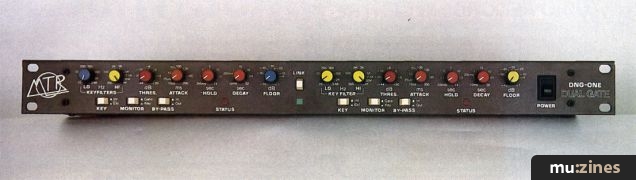
MTR DNG-1 Dual Gate
(HSR Jun 86)

MTR DNG-One (Dual Noise Gate)
(IT Dec 86)

MTR DNG-ONE Dual Gate
(SOS Aug 86)
Browse category: Studio/Rack FX > MTR
Publisher: International Musician & Recording World - Cover Publications Ltd, Northern & Shell Ltd.
The current copyright owner/s of this content may differ from the originally published copyright notice.
More details on copyright ownership...

International Musician - Jul 1986
Recording World
Review by Jim Betteridge
Ads for Gear in this article:
Help Support The Things You Love
mu:zines is the result of thousands of hours of effort, and will require many thousands more going forward to reach our goals of getting all this content online.
If you value this resource, you can support this project - it really helps!
Donations for May 2026
Issues donated this month: 0
New issues that have been donated or scanned for us this month.
Funds donated this month: £0.00
All donations and support are gratefully appreciated - thank you.
Magazines Needed - Can You Help?
Do you have any of these magazine issues?
If so, and you can donate, lend or scan them to help complete our archive, please get in touch via the Contribute page - thanks!
Please Contribute to mu:zines by supplying magazines, scanning or donating funds. Thanks!
Monetary donations go towards site running costs, and the occasional coffee for me if there's anything left over!

 @mu_zines
 RSS Feed
 Blog
Blog