


Magazine Archive
Home -> Magazines -> Issues -> Articles in this issue -> View
M/A/R/R/S | |
M/A/R/R/SArticle from Music Technology, November 1987 | |
Making new music from old. Simon Trask talks to the musicians and DJs who made a No. 1 hit from a drum machine and other peoples' records.
Mix sequenced drums and bass with cut and scratched records and the result is an extremely unlikely No. 1 single. M/A/R/R/S pump up the volume on musical theft.

WHILE MICHAEL JACKSON's Bad LP was racing up the album charts to the number one spot, a track by an unknown group called M/A/R/R/S was beating a similarly swift path up the singles charts.
Yet while Bad was backed by a major record company and a massive publicity budget, M/A/R/R/S' 'Pump Up The Volume' made it to the top on merit alone. The track was originally released into the clubs on white label, meaning there were precious few details about its origins. Its relentless energy and youthful bravado, coupling the tempo and rhythm of house music with the cutting and scratching techniques of hip hop, made it an instant dancefloor hit.
The original 12-inch mix of 'Pump Up The Volume' was given its official release after only five weeks in the clubs, and immediately jumped to 35 in the Gallup singles chart. With subsequent seven-inch and 12-inch remix releases the record climbed to No. 11, then No. 2, and finally to No. 1 - all in the space of four weeks. It held the prime position for two weeks before being toppled by the nondescript mush of the Bee Gees.
But 'Pump Up The Volume' is just the most visible aspect of a whole musical culture which has little to do with songs in the traditional sense. Its commercial success, then, is unusual enough, but even more unusual is the label on which it was released: none other than Ivo Watts-Russell's 4AD, home of the Cocteau Twins and This Mortal Coil, and not a label previously associated with dance music.
'Pump Up The Volume' (incidentally, the title is a line from Eric B and Rakim's 'I Know You Got Soul' which appears at various points in the track) is not only 4AD's first No. 1 record, but also the first No. 1 to be distributed by the Cartel. Yet, far from being a calculated move on the record company's part, the success of the track has taken them completely by surprise.
By now, most people know that M/A/R/R/S is in fact a collaboration between two 4AD acts. Not the Cocteaus and This Mortal Coil, but the Colourbox duo of Martyn and Steve Young, along with AR Kane. Add two DJs, Dave Dorrell and Chris 'CJ' Mackintosh, to the mix (literally) and you've got perhaps the most unusual combination of the year.
Colourbox are one of those groups who release a record every now and then to universal acclaim, without actually hitting the proverbial jackpot. Yet for anyone who knows the scope of the group's recorded output, 'Pump Up The Volume' will come as no surprise. From the authentic reggae of 'Baby I Love You So' and the pure pop of 'Suspicion' to the sixties soul recreation of 'You Keep Me Hanging On' and the warped dub/funk experiments of 'Shotgun', Colourbox's music recognises no boundaries. 'Nation', a track which dates back to 1983, features an archetypal house synthesised bass line which pre-dates house music, and combines it with rock rhythms and dub techniques.
Dorrell and Mackintosh are top London club DJs. Dorrell is well-known as resident DJ at the trendy Raw club, while Mackintosh's expert scratch-mixing has brought him the 1987 UK DJ Mixing Championship crown. In addition, he is responsible for the scratch mix of Sly and Robbie's 'Boops' hit, and currently has his own record 'The Tables Are Turnin'' on release.
Eager to find out more about this unusual collaboration, I headed for Blackwing Studios in South London, where the Colourbox duo together with DJs Dorrell and Mackintosh were about to start the US remix of 'Pump Up The Volume'.
The unexpected success of the track is not something that sits easily on the shoulders of Martyn and Steve Young, who have always preferred anonymity to the glare of the spotlight. But they seemed happy to talk music, as opposed to the colour of their socks and other popstar trivia that usually accompanies chart success.
More specifically, Martyn Young and Dave Dorrell were to be my guides to the planet of M/A/R/R/S, while the other half of the quartet confined themselves to occasional interjections. We began with the inevitable opener: just how did M/A/R/R/S come about?
Young: "It was an idea of Ivo's that Steve and I should collaborate with AR Kane, but it just didn't work out. There's no common ground between us; we work in completely different ways. For 'Pump Up The Volume' they came in and did guitar feedback over the track for six minutes, and we picked out a couple of sections.
"Steve and I wrote the rhythm track with a view to doing scratching and cutting on top of it. There was a gap between us doing the drum track and AR Kane doing their bit, and in that gap we got in Dave and CJ. The track is really a collaboration with them, rather than with AR Kane."
The Colourboxers have used cut-ups previously (for instance on the 1985 track 'Just Give 'Em Whisky', where film and TV clips are overlaid on a rock beat), so employing the cut-up merchants of the turntables was a fairly logical step for '87. 'Pump Up The Volume' features virtually no sampling, all the cuts and scratches being done live on the turntables by the two DJs.
"They know what works and what doesn't", comments Young. "It's a knowledge that a lot of musicians don't have. I certainly didn't, though maybe I have a little more now."
The Young brothers have been exploring the possibilities offered by drum machines since the group's first release, 'Breakdown', back in 1982. Today, 'Pump Up The Volume' finds them still pushing the technology to its limits.
Martyn Young: "For the rhythm track we wanted to experiment with high resolutions, which was something we'd never done before. We used an SP12 in step time, which allowed us to shift beats in 96ths. Since then we've got a 192nd-of-a-beat resolution by treating two crotchets as one and then doubling the speed of the drum machine; it gives an even better feel."
"Dave Darrell: The three-minute pop song is really quite an artificial, cosmetic format."
The bassline required a different approach, however, as their MC500 sequencer couldn't handle the step-time resolution they were looking for.
Young: "We had to sequence two patterns: one for the notes that fell on eighths and one for the notes that didn't, and then shift the second pattern using a delay line to get the slight changes in timing which give the bassline its particular feel."
They've since acquired a Steinberg Pro 16, which takes them a lot closer to the resolution they're looking for, but are already on the lookout for a sequencing package which offers even finer resolution.
"We do most of our stuff in step time, now. In fact, we've forgotten how to play keyboards. We have to work that way. A slight mistake - shifting by a couple of 96ths, say - and it doesn't really work.

"The cold, mathematical approach is more interesting for us, anyway. It's why 'Pump Up The Volume' has such a shuffling feel. That's one of the things in the track's favour that many people haven't realised. What we're doing is still rigid, but it's got more bounce to it."
There seems to be a contrast between the preprogrammed precision of the approach of the brothers Young and the manual dexterity and spontaneity of the two DJs. But which approach is quicker, ultimately?
Dorrell: "Our side of things is quicker once we've selected what records to use. But while it takes Martyn 'x' days to do the drum track, it takes us 'x' years to know all those records."
Martyn and Steve Young's fascination with capturing the nuances of "live" playing in their drum-machine programming has led them to Keith Leblanc, with whom they're planning to work. They cite him as an example of a drummer who is able to transfer the feel of his drumming to a drum machine. Hands up who said drum machines would make drummers redundant?
Martyn Young identifies a trend in dance music away from the mechanical perfection of drum machines:
"I think that's why all the rare groove stuff has caught on, the whole James Brown fixation. It hasn't been possible to synthesise all that stuff until now. People in clubs have become a bit bored with a mechanical beat.
"On the Eric B track 'I Know You Got Soul' they had to use old records to get that feel. That's the sort of timing we're talking about, where you need 192nd shifts. On 'Pump Up The Volume' we've got the rare groove feel with a house-style rhythm. We're really pleased with that.
"As far as we know, no-one else is doing what we're doing. Even Arthur Baker on 'Put The Needle To The Record' - to get that resolution he had to take the rhythm from an old Motown record (Magic Disco's 'Scratching'). So we realised that he hadn't sussed out what was happening, which quite chuffed us.
"We've been trying to emulate a James Brown track called 'Give It Up Turn It Loose'. When the drums come in on that it's brilliant, but we just haven't got a fine enough resolution to capture it yet. We're going to ridiculously small timings. It's quite technical."
Dorrell: "There's a lot of tracks that use looped breaks from records with a drum-machine beat whacked over the top, because people can't actually emulate the feel of those breaks using a drum machine.
"Martyn Young: 'Pump Up The Volume' is the only record I've done that I haven't got bored with."
"A good English example at the moment is Derek B's 'Get Down', which uses an old Studio One reggae/funk rhythm called 'Greedy G'." (A dub version of James Brown's 'Get On The Good Foot'; there's no avoiding the man.) "All they've done is whack a massive drum beat over the top and keep floating the 'Greedy G' rhythm underneath."
Steve Young: "There's been an interesting development in that record: two drum patterns from two different records running at the same time, sync'd up. The spin-offs from people doing things like that can be really good. For instance, you could try doing the same sort of thing with drum machines and sequencers."
Dorrell: "We've done it on 'Pump Up The Volume', in the Iranian vocal section. The bottom layer is the bass drum from 'Pump Up The Volume'. On top of that is a break, and on top of that is another break, then the first layer of vocals, and then the second layer of vocals. So you've got three drum patterns all running at the same time. That was sync'd up manually, with CJ continually adjusting the speed of the decks to keep everything in time."
IN ADDITION TO the breaks, 'Pump Up The Volume' uses scratched-in extracts from many sources including Public Enemy's 'Rebel Without A Pause', Original Concept's 'Pump That Bass', Trouble Funk's 'Pump Me Up', Pressure Drop's 'Rock The House' and the Criminal Element Orchestra's 'Put The Needle To The Record'. Using bits of other people's records is nothing new in this day and age. In fact, it's an integral part of hip hop. But one scratched-in record on the remix of 'Pump Up The Volume' is causing 4AD a lot of legal headaches.
Young: "There's thousands of records that use sampling, and we just wanted to be in amongst them. But now that the record's been so successful we're just like sitting ducks.
"My own feeling is that the samples on 'Pump Up The Volume' are used in a creative way. From our point of view we don't really infringe anyone in the way that we use samples. But there are other people who would disagree, I suppose.
"It's more like a collage of sounds. Artists were doing it years ago, and they didn't have any problems with copyright. We're just doing the same sort of thing."
The problem record is Stock, Aitken and Waterman's 'Roadblock', from which a short section is scratched in. It now looks certain that Pete Waterman will sue 4AD over unauthorised use of the record. If so, the action will become a test case for a grey legal area regarding the use of sampled performances (as opposed to sampled sounds), with potentially wide-ranging repercussions for the music industry.
Alongside this case lies another potential legal wrangle, this time concerning 'Pump Up The Volume' and the Phil Harding and Pete Waterman Red Ink remix of Sybil's 'My Love Is Guaranteed'. The disagreement in this instance is between Blue Mountain Music (publishers of the M/A/R/R/S track) and Intersong (publishers of the Sybil track). This is quite distinct from the 'Roadblock' case, as it is about wholesale copying, with the backing track of the Red Ink mix bearing a striking similarity to that of 'Pump Up The Volume'.
Traditionally, copyright is invested in the melodic and harmonic aspects of a piece of music, with rhythm coming a poor third. But in this instance, there is no melody in the traditional sense, and harmonically both tracks never move from the root of A minor - hardly grounds for sueing. Blue Mountain's contention is firstly that the bassline is the nearest thing to a melody on 'Pump Up The Volume', and secondly that it's permissible for the bass to carry a melody line. Intersong of course maintain otherwise.
The M/A/R/R/S foursome are most interested in the fact that Harding and Waterman haven't managed to recreate the feel of 'Pump Up The Volume'.

DJ Dorrell can't resist the opportunity to tell of fellow DJs' ingenuity: "I know DJs in London now who get the original Sybil import 12-inch and stick the a capella track over 'Pump Up The Volume' 'cos it sounds better."
There's no turning back now. The technology is available, whether it's a pair of record decks or a digital sampler, and the use of sampled performances has become an integral part of much of today's most adventurous music. It's time the lines in the new sampling debate were drawn.
Young: "I think technology dictates a lot of what you do. If there's stuff there then you've got to use it. Technology's dictating the way that music's going.
"Martyn Young: Everyone has their own view of where the line between plagiarism and creativity lies."
"When the stuff that's happening at IRCAM crosses over - basically when the likes of me can afford it - then sound and rhythm will really start to get interesting. The things they were doing on that Tomorrow's World programme [a recent special on technology in music] were completely new to me. There was an incredible human voice sound which transformed into a guitar note with such subtle changes. I'd like to get my hands on that technology. Do you think we could get in there?"
I didn't like to say that musicians working in popular music have about as much chance of getting into IRCAM as Pierre Boulez has of writing a number one hit.
Dorrell takes up the pro-sampling argument: "Recently I was listening to Eric B and Rakim's 'I Know You Got Soul' for the first time in ages. When the 'Pump Up The Volume' phrase comes in it just sounds different; you can recognise it, but it's not what we've done with it. It's all down to the context of the phrase.
"I heard about a recent court case in the States where the ruling was in favour of the samplers who were being prosecuted, because the samples were deemed by the judge to have been artistically and creatively used."
So why not just get someone into the studio to do a voice-over of the "pump up the volume" phrase and save all the hassle?
Young: "It's not the same. It just doesn't have the same sound. We've had to redo some stuff for America, and rewrite some words; anyone who hears the track will know exactly what we've done. We've got round the copyright problem, but in doing that we've done something which to us is worse."
Dorrell: "We've bastardised it. Which is a shame because, in the context it was being used, the original was brilliant. Through making changes you demean the track. You don't enhance it by doing everything yourself."
"Drawing on other sources", interjects Young, "is what gives a track its collage effect. You have different reverbs, different sounds, different feels... It's the mixture of all those things going together."
Could it be that people are listening to music in a different way in these modern times?
"Definitely", asserts Dorrell. "Listen to Double Dee and Steinski's 'Lesson One', 'Lesson Two' and 'Lesson Three' - particularly 'Three', which is the breaks track. If you can listen to that then you can listen to our track no problem. We only use three different breaks, whereas Steinski on that track uses 10 or more. At the moment I think what we've done is sufficient. It's a kind of halfway house; we've taken it on, but not so far that people can't follow."
Young: "It's the boredom threshold, too. People have a very low boredom threshold nowadays. There's this rhythm that's constant; if you can keep that going but give people something to listen to that changes then it's a good effect.
"I could never listen to a record for more than 30 seconds. But now our music is giving people more stuff in less time. 'Pump Up The Volume' is the only record I've done that I haven't got bored with.
"People are definitely listening to music in a different way now. Anyone who listens to house music from the outside probably can't understand what the hell's going on. People on the inside hear the way the instruments cut in and out of one another; it's almost like a dub. As a musician I've always listened like that." Dorrell warms to the subject: "Rhythms are replacing songs. People can listen to rhythms now, without necessarily dancing.
"The three-minute pop song is really quite an artificial, cosmetic format. Records have got longer. In the beginning, singles were two or three minutes long - Elvis Presley's 'Mystery Train' and stuff like that. In the '70s the 12-inch format gave everyone the extension they wanted. Then continuous BPMs in clubs were a further extension, inasmuch as you could extend the music from 10 minutes to 10 hours through mixing. You take the peaks and rolls as a totality, ending up with a massive canvas as opposed to a miniature. That's something to grasp."
So what happens to song structure?
Young: "There are remnants of a song structure in 'Pump Up The Volume'; it hasn't been completely destroyed. We view the piano as the chorus, and the gaps in between as the verses. Maybe people appreciate that subconsciously rather than consciously."
So come clean, guys. Is it OK to take anything from anywhere? The talkative duo have their final say.
Young: "Yes, but you can't draw a line as to where people should stop. Everyone has their own view of where the line between plagiarism and creativity lies."
What about lifting a whole rhythm track? Dorrell: "People have been pinching rhythm tracks for years. Why stop there? The Rolling Stones ripped off a whole genre."
They did indeed.
Publisher: Music Technology - Music Maker Publications (UK), Future Publishing.
The current copyright owner/s of this content may differ from the originally published copyright notice.
More details on copyright ownership...
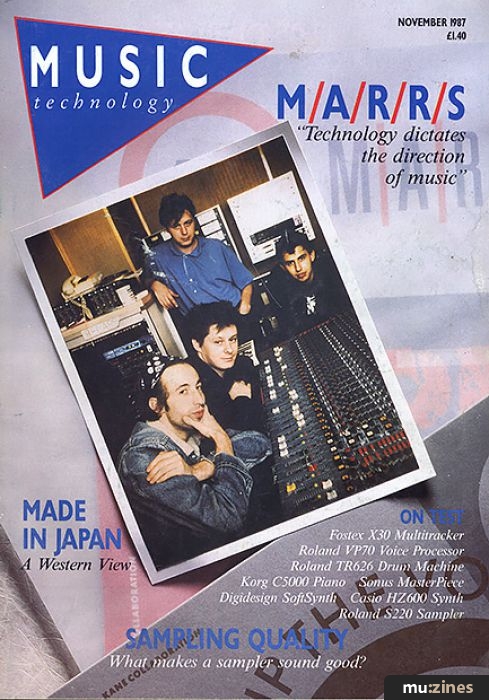
Music Technology - Nov 1987
Donated & scanned by: Mike Gorman
Interview by Simon Trask
Help Support The Things You Love
mu:zines is the result of thousands of hours of effort, and will require many thousands more going forward to reach our goals of getting all this content online.
If you value this resource, you can support this project - it really helps!
Donations for April 2026
Issues donated this month: 0
New issues that have been donated or scanned for us this month.
Funds donated this month: £0.00
All donations and support are gratefully appreciated - thank you.
Magazines Needed - Can You Help?
Do you have any of these magazine issues?
If so, and you can donate, lend or scan them to help complete our archive, please get in touch via the Contribute page - thanks!
Please Contribute to mu:zines by supplying magazines, scanning or donating funds. Thanks!
Monetary donations go towards site running costs, and the occasional coffee for me if there's anything left over!

 @mu_zines
 RSS Feed
 Blog
Blog