


Magazine Archive
Home -> Magazines -> Issues -> Articles in this issue -> View
JBL's Control Micro Monitors | |
Article from Recording Musician, February 1993 | |
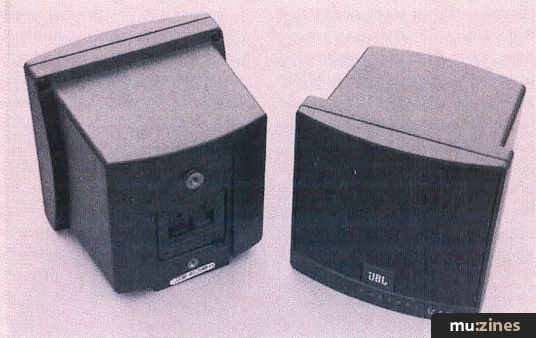
JBL's Control Micro is the smallest speaker in their Control range, designed to fill a variety of needs, including small-scale audio monitoring in AV suites, home entertainment, and small installations such as clubs or pubs. With a baffle size of approximately 150 x 160mm, the Control Micro is built into a well-damped, moulded ABS enclosure with threaded inserts in the back panel for mounting accessories. Black and white versions are available, and simple mounting plates are included as standard.
Connection to the speaker is via conventional sprung terminals and, unlike other models in the Control series, the Micro utilises a single 125mm driver with a composite cone — no tweeter or crossover. A perforated metal grille affords the driver a high degree of physical protection.
Rated at a maximum of 40 watts (programme), the Control Micro covers the frequency range 100Hz to 20kHz, and though this is clearly inadequate for serious mixing work, it does provide a valuable secondary reference when checking that mixes will sound acceptable on small domestic sound systems, car stereos and portable music centres. To make the speakers suitable for use in an AV environment, field-cancelling magnets are fitted to reduce the effect of the loudspeaker magnets on video monitors. This does not, however, afford complete protection from magnetic fields, and in my tests it was found that some picture disturbance was still evident if the speakers were brought within six inches or so of my computer monitor.
The sensitivity of these speakers is not particularly high, at 85dB measured at 1m with a 2v signal applied, so an amplifier rated at between 30W and 50W per channel would be ideal — lower powered amps might lead to premature clipping.
Tonally, the Control Micros sound similar to the other models in the range, in that they are voiced to emphasise high frequency detail rather than being designed for absolute honesty. The inevitable lack of bass also gives them more of a 'boxy' sound, but they are still capable of producing a reasonably high level of sound without significant distortion. One positive benefit of the lack of bass is that it is easier to hear the important midrange detail in a mix, and in this respect, the lack of any form of crossover results in a relatively natural mid-range performance.
Overall, the Control Micros are beautifully packaged, reassuringly robust and provide a valuable secondary reference, but I feel that they are rather overpriced considering their performance which, though adequate, is unexceptional.
Further Information
JBL Control Micros £141 including VAT.
Harmon Audio, (Contact Details).
Publisher: Recording Musician - SOS Publications Ltd.
The contents of this magazine are re-published here with the kind permission of SOS Publications Ltd.
The current copyright owner/s of this content may differ from the originally published copyright notice.
More details on copyright ownership...
Recording Musician - Feb 1993
Donated & scanned by: Mike Gorman
Review by Paul White
Help Support The Things You Love
mu:zines is the result of thousands of hours of effort, and will require many thousands more going forward to reach our goals of getting all this content online.
If you value this resource, you can support this project - it really helps!
Donations for May 2026
Issues donated this month: 0
New issues that have been donated or scanned for us this month.
Funds donated this month: £0.00
All donations and support are gratefully appreciated - thank you.
Magazines Needed - Can You Help?
Do you have any of these magazine issues?
If so, and you can donate, lend or scan them to help complete our archive, please get in touch via the Contribute page - thanks!
Please Contribute to mu:zines by supplying magazines, scanning or donating funds. Thanks!
Monetary donations go towards site running costs, and the occasional coffee for me if there's anything left over!

 @mu_zines
 RSS Feed
 Blog
Blog