


Magazine Archive
Home -> Magazines -> Issues -> Articles in this issue -> View
Going Dutch | |
Article from Sound On Sound, January 1987 | |
It took the importing enterprise of Audio Services to bring us a new range of well-priced effect units from Dutch company IQ Systems. Sound engineer Gareth Stuart checks out two of the range: the dual noise gate, and stereo clarifier - a psychoacoustic sound enhancer.
Sound engineer Gareth Stuart investigates two, newly-imported, low cost effects units from Dutch company IQ Systems - a dual noise gate and a stereo clarifier.

I thought I'd start by taking a look at the stereo clarifier, as its function isn't necessarily that clear from its title. Essentially, the stereo clarifier adds a form of 'aural excitement' and brightens up the processed sound, giving it more, how should I say, 'zing'...
Before I go on to explain how this brightness is achieved, it's necessary to understand that all sounds are made up of their fundamental pitch (which we hear) and a series of overtones, or harmonics, which become gradually less audible as they ascend in pitch. The presence of this series of harmonics above the fundamental pitch in varying proportions, is what gives an instrument its individual sound - its identity, its timbre. The stereo clarifier focuses on these harmonics and by boosting them is able to add extra brightness to the sound without adding greatly to the overall level.
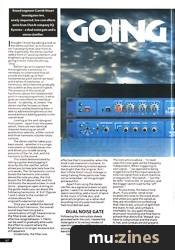
Looking at the well-designed front panel - apart from the power switch, there are two identical channels featuring an on/off pushbutton selector, a filter control and three harmonic volume rotary controls.
The stereo clarifier takes your basic sound - whether it is a single instrument or finished stereo mix - and allows you to add varying amounts of the 1st, 2nd, and 3rd harmonic to the sound.
This is best demonstrated by taking a guitar and plugging it directly into the clarifier, which allows you to hear precisely how the unit works. The 1st harmonic control boosts the harmonic one octave above the note you play, the 2nd boosts the 5th above that, and the 3rd boosts the second octave. In note terms - playing an open A string on the guitar means you can boost the following harmonics: A1 E A2 (figures 1 and 2 relate to the number of octaves above the original/fundamental note).
Once you've added the desired blend of each harmonic, the overall sound may have too great a concentration of high frequencies so the filter knob, which has an effective range between 1-10kHz, can be used to gradually attenuate the effect to a point where the brightness is no longer excessive but still apparent.
Incidentally, the filter is so effective that it is possible, when the knob is set maximum clockwise, to make a sound being treated appear less bright than the original. But I don't think there's much mileage in using it along those particular lines. Let us remember: all things bright are beautiful.
Apart from using the stereo clarifier as a signal processor on solo guitar, I used it to revitalise an ailing opera recording, add a touch of spice to the music of a folk duo, and generally brighten up a rather dull sounding mix of a pop/rock band I had recorded last year.
DUAL NOISE GATE
Following the instruction sheets provided with the unit, I tested the noise gate in its various modes of operation on a few different sound sources taken from the standard band line-up.
I began by gating a bass drum.
The instructions advise - "In most cases the noise gate will be frequency independent. When triggering its own signal..." (as opposed to being triggered via the Key Input jack by an external signal from a drum machine, or sequencer) "the switch..." (on the far left) "is set to the 'in' position, and the trigger switch is set to the 'off' position."
As you know, the bass or kick drum, if you prefer, tends to be located very close to the snare drum, and unless you gate the signals as they are recorded (not something that I like to do), a touch of spill from the snare, hi-hat, and cymbals is inevitable. So, you gate the bass drum post-recording and find that to achieve that distinctive 'thwack' you have to compromise and the snare, hi-hat, and cymbals are still present, but to a lesser degree. Such is life.
In this case, the setting of the gate's threshold level can be critical. Very often, if it is set too high, only about 80% of the bass drum strikes will cause the gate to open, and that's not good enough. If it's set too low, the spill from other areas of the kit make it difficult to adjust the equalisation on just that one sound. Rather than having a bright, almost clicky, bass drum sound, you have harsh, edgy cymbals sizzling away in the background.
Instead of having to patch an external equaliser into a sidechain, as on a Drawmer gate, the IQ unit's trigger frequency control lets the gate work on the chosen frequency only, through its built-in peak filter. The frequency ranges you can tune into are between 400Hz to 10kHz in the HF (high frequency) mode, and between 20Hz and 500Hz in the LF (low frequency) mode, and the overlap increases flexibility.
Both settings give the same amount of 'thwack' to the bass drum sound, and allow for the other sounds to be filtered out equally well. In this example, the HF setting gave a slightly less boomy, or 'umphy' sound - more of a solid, firm 'thwack'.
Setting a fast rise time for the attack control gives edge to the otherwise deep, round sound, and a fast release turns down the volume (ie. causes the gate to close) immediately after the initial sound to give maximum separation.
To gate a snare drum, I found that a fast attack and a slowish release time gave the most natural sound, while at the same time attenuating most undesirable spillage from the rest of the kit. Flicking the trigger frequency control into its LF mode with the small switch, helped attenuate the spillage further and gave a deeper, more full-bodied snare sound.
On vocals it worked equally well, when used with quite a fast attack and a slow release. The trigger frequency control was less effective here, because the range of vowels and consonants made it surge every now and then, undesirably accenting words at random.
Two LEDs, positioned to the left of the threshold knob, act as a visual aid in operating the gate. When the input signal rises above the threshold setting, a green LED comes on. As the signal falls below the threshold, the green LED immediately turns off and a red LED lights, showing that the gate action is functioning. With a fast release time setting, the red LED comes on straight away, as the signal below the threshold is attenuated very sharply. With a slow release, it gradually fades up as the volume is gradually faded down.
CONCLUSION
So, what's my verdict then on the IQ Systems dual noise gate? I think it works well. As a straightforward noise gate, it's fine. Perhaps a little tricky to set up exactly as you want it but, with the trigger frequency option switched in, it is a simple matter to fine tune the gating action - and then a very good result is possible.
If that sounds a little cool, it's not meant to; from the day I received the dual gate for review, I had it out of its box and in the rack working, and I enjoyed using it.
And the stereo clarifier? Yes, I enjoyed using that too. Certainly, the owners of the clarified mixes were more than happy with their 'much freshened' music.
However, it is necessary with the stereo clarifier to use the harmonic boost sparingly on complex sounds, ie. full stereo mixes, especially when boosting the 2nd and 3rd harmonics, as they tend to add a little distortion if you're not careful. On individual instruments though, you can throw caution to the wind, and get into some heavy processing... go for it!
The ability to set the harmonics individually is a very useful feature not found on equivalent devices like the Aphex Type C Exciter, and offers a higher degree of flexibility, allowing the unit to be set up in many different ways to best suit the material it is 'asked' to brighten up. And if you need any more encouragement, let me tell you that once you've installed the stereo clarifier in your sound system, the high frequencies won't just shine, they'll sparkle.
At £250 plus VAT each, both units are very well priced - especially the dual noise gate-and certainly deserve your attention.
List price: £287.50 inc VAT.
(Contact Details)
Publisher: Sound On Sound - SOS Publications Ltd.
The contents of this magazine are re-published here with the kind permission of SOS Publications Ltd.
The current copyright owner/s of this content may differ from the originally published copyright notice.
More details on copyright ownership...

Sound On Sound - Jan 1987
Gear in this article:
Studio/Rack FX > IQ Systems > Stereo Clarifier
Studio/Rack FX > IQ Systems > Dual Noise gate
Gear Tags:
Review by Gareth Stuart
Previous article in this issue:
Next article in this issue:
Help Support The Things You Love
mu:zines is the result of thousands of hours of effort, and will require many thousands more going forward to reach our goals of getting all this content online.
If you value this resource, you can support this project - it really helps!
Donations for May 2026
Issues donated this month: 0
New issues that have been donated or scanned for us this month.
Funds donated this month: £0.00
All donations and support are gratefully appreciated - thank you.
Magazines Needed - Can You Help?
Do you have any of these magazine issues?
If so, and you can donate, lend or scan them to help complete our archive, please get in touch via the Contribute page - thanks!
If you're enjoying the site, please consider supporting me to help build this archive...
...with a one time Donation, or a recurring Donation of just £2 a month. It really helps - thank you!

 @mu_zines
 RSS Feed
 Blog
Blog