Fairlight & Fair Does
(MM Feb 87)


Magazine Archive
Home -> Magazines -> Issues -> Articles in this issue -> View
Fairlight Series III | |
THE ULTIMATE SOFT MACHINEArticle from Sound On Sound, September 1986 | |
The Fairlight (in its previous Series II guise) was/is probably the most famous computer musical instrument in the world. Everybody knows the name, but few really know what its true capabilities are. Now there is a new breed of Fairlight, far more powerful and far more sophisticated than the old one ever was - the Series III. Richard Elen takes a look at the mind-boggling potential of this Rolls-Royce of sound sampling/synthesizing machines.
The Fairlight Series III is one of the most advanced musical instruments in the marketplace today. A superb integration of hardware and software, it offers a wide range of music realisation facilities and Compact Disc digital sound quality to those successful enough to afford it. But as Richard Elen found out, it's a machine whose true capabilities are realised by only a few of its end users.

There are only a few systems around that approach the sheer sophistication of an instrument like the Fairlight Series III when it comes to realising complete pieces of music on a single system. It is not a synthesizer; neither is it a sampler; neither is it a sequencer. It is all three, yet it is more than the sum of those parts. When Director of Research Peter Vogel, and Managing Director Kim Ryrie of Fairlight Instruments created the original Computer Musical Instrument, the Series I CMI, they named it carefully - and well.
A few years is a short time in the digital world, and the Series I has been superseded several times. Today's Series III offers digital sound quality equivalent to that of Compact Disc - 16-bit with up to 90+ dB dynamic range and up to 100kHz sampling rate (around 50kHz in stereo). Owners say that the quality exceeds that of its major rival, the Synclavier - but as Roger Bolton of Syco Systems, the UK distributors of the system since the beginning, is at pains to point out, "That's rather too subjective to comment upon!"
Roger has been working with Fairlight's music systems (the company also produces a very cost-effective video effects processor, the CVI or Computer Video Instrument, and the Voicetracker, a comprehensive pitch-to-MIDI conversion system) for over two years, and he's a confirmed Fairlight addict. "I feel virtually married to it," he says, and is quick to draw attention to the major features of the system, of which sound quality is only one.
The software, for example, is heading rapidly towards the icon and window-driven approach pioneered commercially in the Apple Lisa and Macintosh computers. The screen dumps included with this feature are of the latest software revision, where the icon structure had just been introduced. "The next major software release," says Roger Bolton, "will be in September, and it'll look a lot different, as much more will be icon-driven."
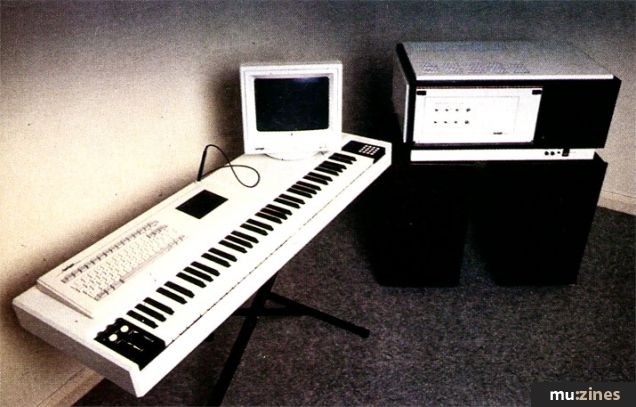
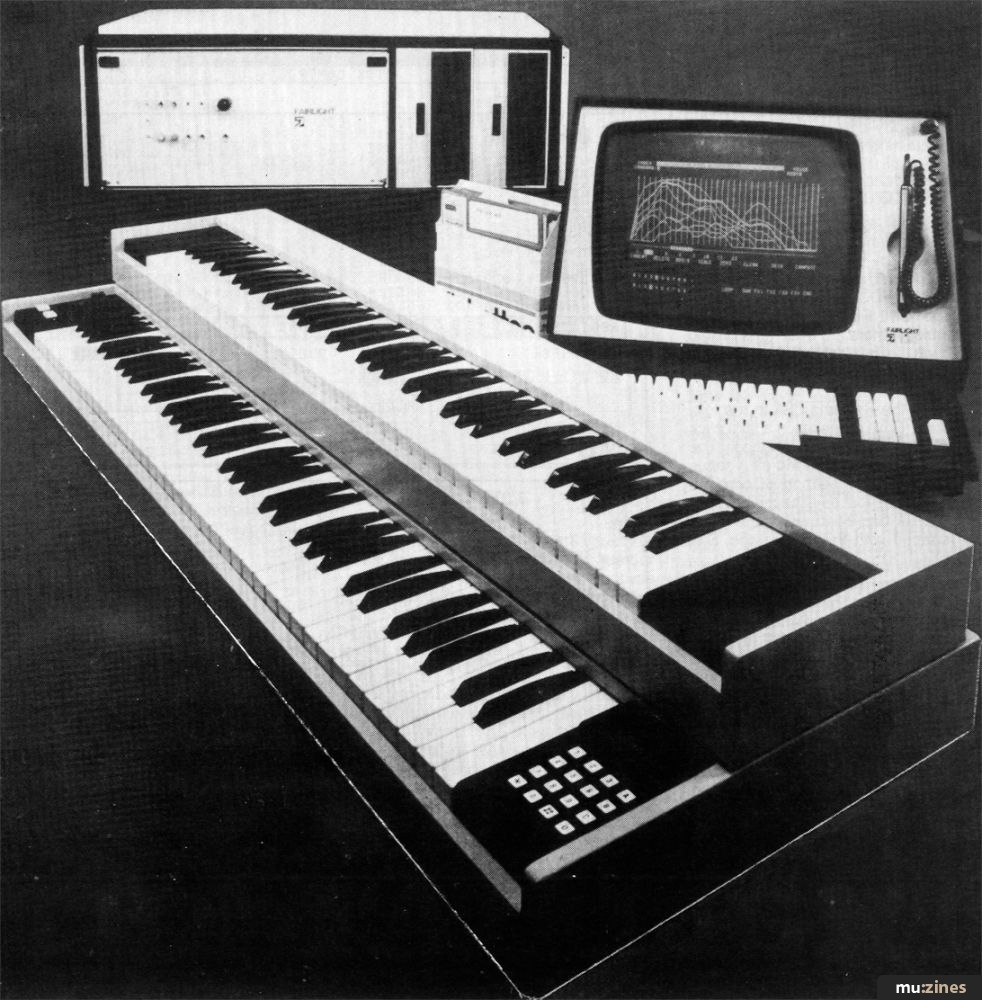
The Fairlight has always used an optional, non-keyboard method of inputting commands. Formerly it was a light-pen attached to the green-screen monitor; now on the Series III it's a graphics tablet with stylus, presented as part of the alphanumeric keyboard which, with the monitor, sits atop the music keyboard. The stylus is used on the rubbery surface of the pressure-sensitive tablet like a pencil: as you move the stylus, a cursor tracks its relative position on-screen. With this, as with the 'mouse' on a modern microcomputer, you can reduce typing and concentrate on the music keyboard - a full six octave job with a good feel. It includes a numeric keypad for performance applications, a set of programmable function performance controllers - wheels, switches and knobs - and has a full MIDI (Musical Instrument Digital Interface) implementation.
Purely as a computer system, the Series III is a high-powered, multiprocessor machine. Music operations, whether it's handling samples or synthesized sounds, sequences or editing, require large amounts of memory - and in the Series III you can have up to 14 Megabytes (MB) of waveform RAM (Random Access Memory) per 16 channels, giving over two minutes sampling time at 48kHz. In addition, they need fast number-crunching and data handling capability.
Often it's impossible to do this even with a modern 16/32-bit microprocessor like the 68000, the chip at the heart of the Apple Macintosh and Atari ST series of micros (although no doubt parallel-processing systems like the British Transputer will change this over the coming years).
Particularly when it comes down to handling an instrument's voices, 'distributed processing' (where individual processors handle the 'business end' of sound generation and output, and handling data coming into and out of the system from disk drives, keyboard or whatever, while they are directed by a central command processor) is a useful technique, if not essential. In the case of the Fairlight Series III, two 68000 processors are 'in charge', and no less than ten 6809 micros - a 'smaller brother' of the 68000 - do the dirty work. One of the 68000 chips is the 'performance CPU', while the other is the 'waveform processor', addressing up to the full 14 Megabytes of waveform memory.

The result is that the central 'brain' of the Fairlight - a rack containing processing, voice/channel cards and power supplies - is a powerful computer in its own right, running Motorola's OS-9 - a powerful multi-tasking (ie. it can do several jobs at once) operating system that enables the Series III to carry out word processing and other business computing functions as well as its primary task of making music.
The theme of basing the instrument round a powerful, but friendly, computer is continued into the large amount of mass storage available. The original Fairlight Series I used twin 8" floppy disks - very much a dying breed since the introduction of 5¼" and now 3½" floppies. But the Series III retains a single 8" floppy drive: simply because they are that much more reliable than the smaller disks, and they're still a well-recognised industry standard. The double-sided, double-density drive can store 1 Megabyte (MB) of data.
In addition, however, there's a 5¼" Winchester hard disk drive - storing either 70 or 110 MB. Soon it will be possible to record direct to disk at 48kHz sampling rate, "By December," says Syco's Roger Bolton. "With the 110 MB disk," he continues, "you'll have over eight minutes of sampling to hard disk in stereo, and you'll be able to sequence over the top of it. External hard disks will arrive by October, and we'll be able to daisy-chain at least four of them."
The external drives can be connected in daisy-chain fashion via a SCSI (Small Computer System Interface) port on the Fairlight, and a total of five hard disks online would give you over forty minutes of stereo recording, not including sequencing capability above that, assuming the professional industry standard sampling rate of 48kHz ("The maximum playback rate," says Bolton, "is at present 180kHz, but can be raised if necessary").
What else is in the box? Most important of all, the voice/channel cards, which include separate 16-bit digital to analogue convertors, digitally-controlled filter and amplifier for each card. Up to 16 voices can be accommodated by the basic system, but with external voice racks, you can extend that to no less than 64 voices. In addition, the 3-in/4-out MIDI implementation enables the Fairlight to control other instruments (or even be controlled by them, if you really want to be weird). So there's no lack of ability here to play all the parts you can possibly imagine in a realisation.
As far as interfacing is concerned, aside from MIDI, the system can also read and generate SMPTE (Society of Motion Picture and Television Engineers) timecode, and can sync to it with 'chase' capability allowing the system to follow all the movements of a tape machine. Returning to the sound generation aspect of the instrument, the Fairlight is probably best-known for its sampling capability. Indeed, the original CMI was the first sampling system on the market. Today, it’s certainly still one of the most-used.
But in the beginning it wasn't like that - and this is perhaps one of the sad things about the Fairlight system - and the same can be said of the Synclavier. The Fairlight has always been capable of a great deal more than merely being able to digitally record and playback a set of sounds - on the original instrument, that amounted to perhaps 10% of the system's capabilities. But today, the fashion for sampled sounds has become great (so great, in fact, that sampled sounds used on their own are regarded by a great many record producers as being hackneyed), and Fairlight have been forced to place much more emphasis on the sampling, so the other side of the coin - the ability to generate entirely new sounds by waveform and harmonic synthesis - has faded very much into the background, certainly as far as most end-users are concerned.
In the beginning, the Fairlight was noted for its capability to synthesize a waveform from scratch. You could sit in front of the screen with the light-pen and literally draw a waveform, apply an envelope to it, and use it. This writer well recalls a demonstration at an Audio Engineering Society (AES) Convention in New York a few years ago where Wendy Carlos used a Fairlight to show the effect of waveform synthensis. First she drew a square wave. "We all know what this sounds like," she said: and so it was - we heard the familiar nasal harmonic buzz of such a waveform structure. "Now, what does this sound like?" She took the light-pen and drew a weird, random, jagged waveform on the screen with approximately the same pitch as the previous sound, and played it. It sounded virtually identical.

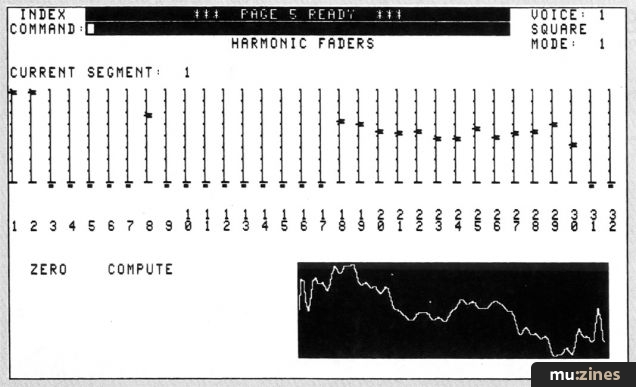
The point was to direct our attention to the importance of envelope control as well as waveforms: that the 'shaping' of a sound in terms of its frequency and amplitude over time was at least as important as its harmonic structure. In truth, both are valuable, and the Fairlight, even in those early days, gave you a great deal of control over all aspects of the sound. Instead of drawing a waveform, for example, you could create a sound with harmonic 'drawbars', adding the desired components of over a dozen harmonics.
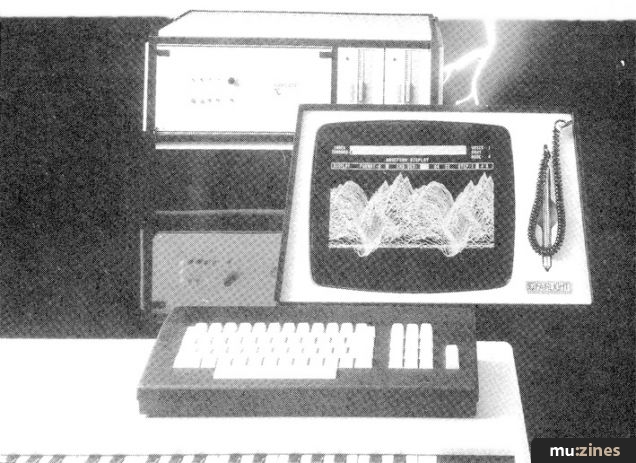
Those possibilities are no less prodigious today: in fact, they are more so. The new Fairlight's equivalent of the waveform drawing and drawbars facility on the Series 1 is the Waveform Editor. This allows waveform drawing and displays harmonic amplitude and phase relationships in a high-resolution graphical form, but it also does much more: it does FFTs... FFTs are "Fast Fourier Transforms", and an FFT capability allows the potential for analysis and resynthesis of existing sounds.
Any sound can theoretically be analysed into a set of sine wave components, all harmonically related, each with a different value. Given such an analysis, the sound can then be 'reconstructed' comparatively straightforwardly with harmonic synthesis techniques. The re-synthesized sound can be controlled and modified much more comprehensively than a mere recorded sample.
But Fourier analysis of a sound has traditionally been slow, difficult and expensive to accomplish. The Series III offers the capability, however, to use FFT techniques practically, to operate on existing sounds or to create entirely new ones.
The only thing is, few people seem to use the vast synthesis capabilities of the machine. Instead, everyone seems to assume that the Fairlight Series III is merely a super-sampler: that the only sounds it can play are other people's. It's simply not true.
One can, however, see the problems faced by many artists utilising - or thinking of utilising - today's sophisticated 'complete systems' approaches to music realisation. Such systems are not cheap. You have to be reasonably successful to be able to afford one. If you can afford one, then you need to spend a lot of time with the system and explore its potential - this is often difficult unless you can justify locking yourself away for three months: many working musicians can't. If you can't afford one, then you'd find it very difficult, if not impossible, to learn any but the most basic of the capabilities of the instrument. So renting one into use on your sessions is of little use: you'll hardly know how to use it (even if the rental company has an arrangement to allow pre-programming).
The alternative is to rent a machine and a programmer. This is also expensive, but so are are a lot of things. More importantly, perhaps, there are two conceptual problems with using a programmer; first, you immediately lose one of the prime benefits of modern music technology, the ability of the composer to be directly responsible for the realisation, and instead and instead you rely someone else to interpret your intention (just as when you use any other session musician, but with the important difference that you won't fully understand the possibilities and limitations of the instrument); second, it would appear that all too often the best programmers are not necessarily the best musicians. All too easily you can end up not enjoying the full benefits of the system because the guy doesn't understand what you wan't to do musically, and you don't understand what he can do technically.
The end result in far too many cases is that a superb instrument like the Fairlight is wheeled into a session, with or without programmer, and is then called upon to regurgitate a bunch of sampled library sounds, simply by loading a few disks; or is used to sample something that could easily have been done on an AMS digital delay. This, surely, is not what it is about.

All this is quite apart from the argument about 'total systems' - where you are reliant on the same manufacturer for his sound generation, sequencing, and sampling approaches, good or bad - versus 'component systems', which enable you to combine what you feel is the best sequencer, say, with a combination of different synths and other instruments that give you a very wide range of sounds, all in smallish blocks that you might be able to afford.
Kevin Stanton - FAIRLIGHT SERIES III USER
Kevin Stanton, ex-member of top Australian band Mi-Sex, is one half of a team - StanLee Productions - based in Australia, and one of that country's leading Fairlight programming outfits. They own one of the first Series III Fairlight machines, and were responsible for many aspects of the initial Series III sound library. For the past few months, however, they have been based in the UK. Richard Elen tracked Kevin Stanton down at Red Bus Studios in North London to record his views on the new Fairlight.
I gather that you have modified your Series III quite extensively.
"Yes, we've taken out all the filters - right up to, but not including, the tracking filter of course. We think it sounds better. It was specially modified by my partner, Spencer Lee and another colleague. The effect is to give a really warm, open sound."
Yours is quite an early model I gather.
"It's serial number 001 - and it's been modified really from day one. The production models sound very good, too, of course!"
How do you find the graphics tablet as compared with the light-pen on the earlier machines?
"Much, much better - although really I only use it for waveform editing. I do everything else from the keyboard."
How did you get involved with Fairlight in the first place?
"We'd been producing in Australia for a long time, and we tend to go for very modern sounds. We just got a phone call, basically - we'd been in touch with the factory for some time, and they asked us to help them get the sound library together, and to help de-bug the software on the user's side for the Series III - this was at the end of last year.
We're working out of our own studio in Sydney - a few blocks from Fairlight themselves - working with their guy who's responsible for the user side of the programming."
What have you been working on?
"We've been concentrating a lot on the sound library - it's a big job, and it's been taking up about 75% of our time. The library contains around 400 sounds so far - most of it has involved taking musicians into our studio, and we've been collecting sounds for years, since we started with the original Series I in fact. After a time you tend to listen, and keep your ears open for new sounds. There's a sound on the Series III, for instance, of a guy hammering a 400ft air-conditioning duct in a newly-built police station in Sydney. We went on to the construction site to sample it! I've done one piece of music based on sounds from a fireworks display. The whole piece just consists of a choir, fireworks, percussion and bass."
You've also been feeding information back to Fairlight on how the system performs.
"Yes, and we've been getting feedback from people in this country, too. There are over thirty Series III systems here now - we send the users' comments back to the factory. Some of the ideas people have are impossible of course; others can be done in a couple of year's time; while others can be implemented immediately."
What brought you to England?
"We'd been working in Australia for sometime, and we felt we'd reached a ceiling. Then we heard that there was a good chance that we could get some work over here, and we arrived in April. We just thought we'd come here on a trial basis. We've got a band in Australia that we're producing in October, so we'll be going back then. We're hoping that we'll end up being able to spend summers here and summers there! The Series III is really our introduction to this country."
Do you find yourselves using primarily sampled material as the basis of sounds?
"I've always gone for natural sounds myself. I was a classical musician originally, so I've always leaned towards that. But I'm a rock guitarist, too. I use synthesizers as well, of course. I suppose I like to use a combination of the two - some of those combination sounds are really spectacular."
What are you actually offering to people over here?
"Well, we hire out the Series III, and we also use it in our own productions. My partner, Spencer, is also very adept at the SSL console: he takes care of all the arrangements, and half the playing too, playing bass guitar and keyboards. So between us we cover all aspects of production."
Who have you been working with here so far?
"We're just starting to get things together here: we're working with a band on RCA Records at the moment, and we're talking to other record companies. We're just slowly getting our faces around the place. The Fairlight is only one aspect of what we're doing. It's an absolutely fantastic composition and arrangement tool, and the sheer sound quality of it... you can do practically everything but lead vocals on it - in fact you can do those as well, actually!"
So how large a part does the Fairlight play in your work?
"A fairly large part, but it depends on the material. You might do an entire piece on it, or just use it asa drum machine. You can use it in any capacity. Obviously, you're not going to tell a really good drummer, for instance, not to play simply because you're using the Fairlight."
What do you regard as the main improvements of the Series III over the earlier machines?
"It's really a completely different machine. It perhaps does some of the things relatively similarly, but by and large it's completely different. It's a tremendously powerful machine. There's waveform editing and looping; you can sample up to 2 minutes 40 seconds on our particular system, or half that in stereo; also you can have 16 internal voices to compose with at any time on the rhythm sequencer. It's up to 16-note polyphonic, and there's full SMPTE syncing and MIDI capability."
So, do you use it with MIDI very often, either controlling or being driven by MIDI instruments?
"Again, it depends on what sounds you want on a particular session. You always have to use other instruments - unless you went out and sampled every other electronic keyboard. You can't generate sounds like you can from a DX7 or a Prophet, so you use them as sound sources via MIDI or you sample them when you need to - whichever way you want."
Do you therefore make little use of the synthesis capability of the Series III?
"You can use it if it's demanded. I've done a fair amount of experimentation. But I use it largely as a sampling machine, 90% of the time, because of my leaning towards natural sounds. As a synthesis machine I personally find it time consuming - too time consuming to justify on a lot of sessions. You can do waveform synthesis, of course... but in the time it takes to construct a rich, usable sound, you could have written three songs! I haven't yet met anyone who can do it quickly. Mixing and merging sounds on the Series III, of course, is something else!"
I gather that you have modified your Series III quite extensively.
"Yes, we've taken out all the filters - right up to, but not including, the tracking filter of course. We think it sounds better. It was specially modified by my partner, Spencer Lee and another colleague. The effect is to give a really warm, open sound."
Yours is quite an early model I gather.
"It's serial number 001 - and it's been modified really from day one. The production models sound very good, too, of course!"
How do you find the graphics tablet as compared with the light-pen on the earlier machines?
"Much, much better - although really I only use it for waveform editing. I do everything else from the keyboard."
How did you get involved with Fairlight in the first place?
"We'd been producing in Australia for a long time, and we tend to go for very modern sounds. We just got a phone call, basically - we'd been in touch with the factory for some time, and they asked us to help them get the sound library together, and to help de-bug the software on the user's side for the Series III - this was at the end of last year.
We're working out of our own studio in Sydney - a few blocks from Fairlight themselves - working with their guy who's responsible for the user side of the programming."
What have you been working on?
"We've been concentrating a lot on the sound library - it's a big job, and it's been taking up about 75% of our time. The library contains around 400 sounds so far - most of it has involved taking musicians into our studio, and we've been collecting sounds for years, since we started with the original Series I in fact. After a time you tend to listen, and keep your ears open for new sounds. There's a sound on the Series III, for instance, of a guy hammering a 400ft air-conditioning duct in a newly-built police station in Sydney. We went on to the construction site to sample it! I've done one piece of music based on sounds from a fireworks display. The whole piece just consists of a choir, fireworks, percussion and bass."
You've also been feeding information back to Fairlight on how the system performs.
"Yes, and we've been getting feedback from people in this country, too. There are over thirty Series III systems here now - we send the users' comments back to the factory. Some of the ideas people have are impossible of course; others can be done in a couple of year's time; while others can be implemented immediately."
What brought you to England?
"We'd been working in Australia for sometime, and we felt we'd reached a ceiling. Then we heard that there was a good chance that we could get some work over here, and we arrived in April. We just thought we'd come here on a trial basis. We've got a band in Australia that we're producing in October, so we'll be going back then. We're hoping that we'll end up being able to spend summers here and summers there! The Series III is really our introduction to this country."
Do you find yourselves using primarily sampled material as the basis of sounds?
"I've always gone for natural sounds myself. I was a classical musician originally, so I've always leaned towards that. But I'm a rock guitarist, too. I use synthesizers as well, of course. I suppose I like to use a combination of the two - some of those combination sounds are really spectacular."
What are you actually offering to people over here?
"Well, we hire out the Series III, and we also use it in our own productions. My partner, Spencer, is also very adept at the SSL console: he takes care of all the arrangements, and half the playing too, playing bass guitar and keyboards. So between us we cover all aspects of production."
Who have you been working with here so far?
"We're just starting to get things together here: we're working with a band on RCA Records at the moment, and we're talking to other record companies. We're just slowly getting our faces around the place. The Fairlight is only one aspect of what we're doing. It's an absolutely fantastic composition and arrangement tool, and the sheer sound quality of it... you can do practically everything but lead vocals on it - in fact you can do those as well, actually!"
So how large a part does the Fairlight play in your work?
"A fairly large part, but it depends on the material. You might do an entire piece on it, or just use it asa drum machine. You can use it in any capacity. Obviously, you're not going to tell a really good drummer, for instance, not to play simply because you're using the Fairlight."
What do you regard as the main improvements of the Series III over the earlier machines?
"It's really a completely different machine. It perhaps does some of the things relatively similarly, but by and large it's completely different. It's a tremendously powerful machine. There's waveform editing and looping; you can sample up to 2 minutes 40 seconds on our particular system, or half that in stereo; also you can have 16 internal voices to compose with at any time on the rhythm sequencer. It's up to 16-note polyphonic, and there's full SMPTE syncing and MIDI capability."
So, do you use it with MIDI very often, either controlling or being driven by MIDI instruments?
"Again, it depends on what sounds you want on a particular session. You always have to use other instruments - unless you went out and sampled every other electronic keyboard. You can't generate sounds like you can from a DX7 or a Prophet, so you use them as sound sources via MIDI or you sample them when you need to - whichever way you want."
Do you therefore make little use of the synthesis capability of the Series III?
"You can use it if it's demanded. I've done a fair amount of experimentation. But I use it largely as a sampling machine, 90% of the time, because of my leaning towards natural sounds. As a synthesis machine I personally find it time consuming - too time consuming to justify on a lot of sessions. You can do waveform synthesis, of course... but in the time it takes to construct a rich, usable sound, you could have written three songs! I haven't yet met anyone who can do it quickly. Mixing and merging sounds on the Series III, of course, is something else!"
That isn't to say that Fairlight's subsystems (or anyone else's) aren't any good. On the contrary, a look at the Series III reveals some of the most comprehensive music compositional tools, for example, that you'll find. In fact, there are three entirely different methods of sequencing - each offering facilities that are not available in the other, and which suit different ways of working. You can take your pick, and even use more than one method in a single piece.
First of all, there's RS Page, the 'Real-Time Composer' or 'Rhythm Sequencer'. It's an expanded and enhanced version of 'Page R', that first appeared on the Series II Fairlight a few years ago. In essence, it's a musical drum machine program with a visual display. In other words, it's pattern-based. A pattern can contain up to 16 channels which can combine quantised and realtime performances, storing data on pitch, key velocity, duration and key release for each note. These patterns can then be chained to create a song structure. Page R is particularly useful in repetitive material (most pop music, for example), and for establishing the rhythmic basis of a track. It can be tied to SMPTE timecode.
Then there's a new sequencing system called CAPS (Composer, Arranger, Performer, Sequencer). Unfortunately, I haven't had the chance to play with this facility, but according to the Fairlight blurb, "CAPS... is a new concept sequencer which provides compositional assistance by allowing chords and certain performance styles to be specified, simplifying the composition through the production process. It is designed to allow 80 parts to be arranged and also contains facilities to aid in automation of the mixdown process..." A Page R sequence can be transferred into CAPS and, it too, can be SMPTE-linked. Hmm... do me a jam around A, D and E please!
Then, finally, there's MCL, the Music Composition Language. This is exactly what it says: it's like a computer programming language (but simpler), enabling the composer to write a piece into memory with a comprehensive set of musical commands. It's not difficult to use, but I have never seen anyone use it in real life (apart from demonstrations). Once again, perhaps in the circles I move in, people are either too lazy or don't have the time to learn. A pity. Mind you, no doubt Steve Rance, possibly the best programmer in this country, knows it inside out. In fact, he knows the Series III inside out, probably better than Fairlight do themselves!

An instrument system - particularly one as complex and sophisticated as the Fairlight Series III - does not exist alone. Instead, it relies on the continuous support of the manufacturer and distributor network that supplies the instruments to end-users. Fairlight have long-since realised that fact, and have established a worldwide set-up to look after the instruments and their users, establish upgrade paths from earlier models to the latest version, and so on. The principle extends right into the instruments - the Series III contains, built-in, the software required to act as a computer terminal. Called TelNet, the software can be utilised with a modem and a telephone to send information, sounds and sequences across the world at rates up to 1200 baud (1200 bits/second) - although it must be said that with a single sample voice occupying around 128KB (KiloBytes) of RAM, this could take a long time.
More useful is the fact that you can use TelNet to access electronic mail and information services. There are two main sources of data of this type for people in the music business, the 'Performing Artist's Network' (PAN), based in New England, USA, and 'Esi Street', an international network operated by Entertainment Systems International (formerly IMC). These networks will be the subject of a future article.
Fairlight chose to do the majority of their on-line support via the Esi network, and have a 'hotline' electronic mailbox on the system where users can deposit any queries, and a regular electronic publication, 'FiNews', which gives up-to-date information on the world of Fairlight Instruments. The following is an extract:
The Fairlight is a truly international instrument, with a well supported world-wide user base that has helped the new Series III make a unique contribution to the realisation of modern music. It's a unique instrument that is sure to have a long-term place in the development of music technology.
(Contact Details)
Also featuring gear in this article

Fairlight Series III
(EMM Apr 86)
Browse category: Sampler > Fairlight
Featuring related gear

Fairlight CMI Review
(EMM Jun 81)

Fairlight Explained (Part 8)
(EMM May 85)

Fairlight Goes MIDI
(EMM Jun 85)

Synth Computers
(12T Nov 82)
The Fairlight Explained (Part 1)
(EMM Aug 84)

The Fairlight Explained (Part 2)
(EMM Sep 84)

The Fairlight Explained (Part 3)
(EMM Oct 84)

The Fairlight Explained (Part 4)
(EMM Nov 84)
The Fairlight Explained (Part 5)
(EMM Dec 84)

The Fairlight Explained (Part 6)
(EMM Mar 85)

The Fairlight Explained (Part 7)
(EMM Apr 85)
The Fairlight Explained (Part 9)
(EMM Jun 85)
Browse category: Sampler > Fairlight
Publisher: Sound On Sound - SOS Publications Ltd.
The contents of this magazine are re-published here with the kind permission of SOS Publications Ltd.
The current copyright owner/s of this content may differ from the originally published copyright notice.
More details on copyright ownership...

Sound On Sound - Sep 1986
Donated by: Gavin Livingstone
Review by Richard Elen
Ads for Gear in this article:


Help Support The Things You Love
mu:zines is the result of thousands of hours of effort, and will require many thousands more going forward to reach our goals of getting all this content online.
If you value this resource, you can support this project - it really helps!
Donations for September 2026
Issues donated this month: 0
New issues that have been donated or scanned for us this month.
Funds donated this month: £0.00
All donations and support are gratefully appreciated - thank you.
Magazines Needed - Can You Help?
Do you have any of these magazine issues?
If so, and you can donate, lend or scan them to help complete our archive, please get in touch via the Contribute page - thanks!
Please Contribute to mu:zines by supplying magazines, scanning or donating funds. Thanks!
Monetary donations go towards site running costs, and the occasional coffee for me if there's anything left over!

 @mu_zines
 RSS Feed
 Blog
Blog