

Magazine Archive
Home -> Magazines -> Issues -> Articles in this issue -> View
Digitech MIDI Pedal | |
Article from Sound On Sound, July 1988 | |
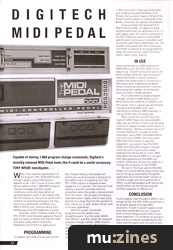
Capable of storing 1,984 program change commands, Digitech's recently released MIDI Pedal looks like it could be a useful accessory. Tony Wride investigates...
Capable of storing 1,984 program change commands, Digitech's recently released MIDI Pedal looks like it could be a useful accessory. Tony Wride investigates...

When I first read the specification of the Digitech PDS-3500 MIDI Pedal I thought what a useful little device it appears to be. I don't know of many other devices able to store 1,984 MIDI program change messages and also supply continuous controller data (when an optional pedal is used). It did indeed look like the solution to many a live performer's problem of switching programs, be they voices on a synthesizer or effects on a MIDI'd effects unit, without taking their hands away from the keyboard or guitar.
However, when I looked closely at the PDS-3500 it soon became apparent that all was not quite so simple and that this little, and quite costly, device had some drawbacks which limit its applications.
PROGRAMMING
To explain, let's look at how you use the box. Despite being a foot pedal unit, which you would presume is designed to live within reach of a passing foot, the PDS-3500 requires a separate power supply for it to operate. The internal 9 volt battery is purely to provide memory protection when the pedal is disconnected from the mains. The prospect of having a separate power supply, and its lead, lying around on a stage floor for the guitarist to kick, stamp on, or spill 'amber nectar' over is not very appealing!
With the power connected, programming the pedal is very straightforward. You first select BANK, then PRESET, and then enter the required program change number, MIDI channel number, and if required a Pedal Status. With the data set you then press the lefthand BANK/STORE footswitch to store the selections in memory. You can then continue and programme the remaining 1,983 memories!! If you spend the time you could end up with 64 Banks of 31 Presets, but you don't have to fill all of the Presets within a Bank, or indeed all of the Banks, since you can specify end markers.
If you purchase the optional FX17 Wah/Volume pedal, or happen to have another pedal that can generate a 0 to +5 volt output, then this can be connected to the PDS-3500 and used to control MIDI specification Continuous Controllers such as volume, pitch bend, aftertouch, etc. The number associated with the Continuous Controller is entered at the programming stage and some of you might find this a useful, albeit costly, feature.
IN USE
Once connected to a MIDI keyboard or MIDI effects unit, the PDS-3500 is very easy to use. The left footswitch selects the Bank number while the right footswitch selects the Preset. A recent software update now means that if a footswitch is held down then it advances the Bank/Preset number by one and then reverses, decreasing the number. A momentary press just gives a single advance.
As an alternative to single program changes, another mode allows you to Bank Dump the contents of a Bank in one fell swoop. This is a good way of remotely changing several MIDI units, each operating on different MIDI channels, in one go at the start of a song, say.
Now comes the crunch! Since the Digitech MIDI Pedal only transmits MIDI data, you are limited in how it can be used unless you happen to have some means of MIDI merging. Taking a common set-up of a master keyboard, a couple of synth expanders, and a MIDI-controlled effects unit such as an SPX90. Since you need MIDI note information to play the expanders, you cannot have the MIDI Pedal controlling the program changes unless by some chance your master keyboard has the facility to 'echo' MIDI data (data received at MIDI In is merged with data appearing at the MIDI Out socket). Otherwise, all you can really do is change the programs on the SPX90.
As I see it, the main use for the MIDI Pedal is to control effects units so that they can be set up as required by the gentle application of a size ten boot! Using it to control a single unit, be it synthesizer or effect, is a bit extravagant and I personally would rather use the money towards another expander or effects unit.
CONCLUSION
If only Digitech had included a MIDI In and merge facility, the PDS-3500 would have a far greater appeal amongst MIDI musicians. A built-in power supply would have been preferable too but I suppose both of these things would make it even more expensive. I'm certainly not going to buy one but no doubt somebody has the need, and the spare cash, for such a unit.
Price £167 inc VAT.
Contact Rhino Distribution Ltd, (Contact Details).
Publisher: Sound On Sound - SOS Publications Ltd.
The contents of this magazine are re-published here with the kind permission of SOS Publications Ltd.
The current copyright owner/s of this content may differ from the originally published copyright notice.
More details on copyright ownership...

Sound On Sound - Jul 1988
Gear in this article:
Review by Tony Wride
Previous article in this issue:
Next article in this issue:
Help Support The Things You Love
mu:zines is the result of thousands of hours of effort, and will require many thousands more going forward to reach our goals of getting all this content online.
If you value this resource, you can support this project - it really helps!
Donations for June 2026
Issues donated this month: 0
New issues that have been donated or scanned for us this month.
Funds donated this month: £0.00
All donations and support are gratefully appreciated - thank you.
Magazines Needed - Can You Help?
Do you have any of these magazine issues?
If so, and you can donate, lend or scan them to help complete our archive, please get in touch via the Contribute page - thanks!
If you're enjoying the site, please consider supporting me to help build this archive...
...with a one time Donation, or a recurring Donation of just £2 a month. It really helps - thank you!

 @mu_zines
 RSS Feed
 Blog
Blog