


Magazine Archive
Home -> Magazines -> Issues -> Articles in this issue -> View
Article Group: | |
Custom 700B Twin Reverb Amp | |
Article from International Musician & Recording World, August 1975 | |
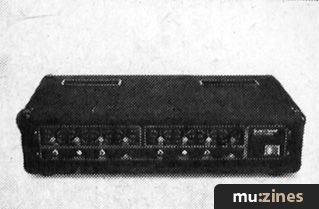
Test Report on: Custom 700B Twin Reverb Amp.
Date: July 1975. £133.50 Ex VAT
Custom Sound is a relative newcomer to the group equipment market place but the name has become surprisingly well established in a very short time. This is mainly due to the competitive nature of their products. The 700 series of amplifiers comprises four models; a 5 channel P.A., a slave, a combination amp. and the amp. top which is the subject of this report.
The amplifier offers 150 watts rms into a 4 ohms load. There are two separate input channels each with volume, bass, treble, presence and reverb controls. Channel one is also fitted with a sustain control which we measured electrically and also sound tested, (see conclusion).
Sensitivity switches are fitted on each channel for Hi/Low switching (see specification figures in table). Footswitches are available for the remote on/off control for reverb and sustain and the footswitch sockets are located on the front panel.
Three output sockets are provided on the back panel for driving studio equipment, headphones, and other power amplifiers (slave output). The speaker output sockets and fuse holders are also on the back panel.
Construction
The unit is constructed on a rigid black anodised metal chassis which slides into a black vynide covered wooden case. The corners of the case are protected with mouldings and feet are fitted to both the bottom and one end. A handle is mounted on the other end which is a far more convenient arrangement than the usual handle mounted in the middle of the top.
The control panel is fully recessed which protects it from transportation knocks and the mains lead is detachable. Mains voltage, permissible speaker combinations, and fuse ratings are all clearly marked on the panel but there is no provision for mains voltage selection.
The last point is not likely to cause much difficulty in the U.K. vs the amplifier is wired for 240 V. operation.
There could be problems for the band that does continental work, however, unless they change a wire over on the double wound mains transformer which is a small soldering operation.
Amplifiers supplied directly from the factory to overseas countries are prewired for 115 volt mains operation. Access to the works for servicing is very easy and involves removing two screws and sliding the chassis out of the case.
Once inside one finds most of the components mounted on three glassfibre printed circuit boards; one for each input channel and one for the power stages. Components are of good quality and some components, such as the input and output jack sockets, which have gold plated contacts, and the knobs which are of the collet type, are of a quality not usually found in group equipment. The standard of soldered joints is good and the small amount of internal wiring is tidy.
The power stage can easily be removed as a single unit for servicing which enables the service dealer to effect a very quick repair should a fault develop in the output stage. Spare output stages are supplied to dealers free of charge during the two year warranty period. The power transistors are in sockets and many of the associated components are mounted on turret tags so they can be replaced without removing the boards if necessary — all good servicing points.
The mains transformer is of good size and the output stage heat sink adequate. The heat sink is mounted inside the box with ventilators above and below it and does not form the back pane! as with most amplifiers.
| Parameter | RESULT | TEST CONDITIONS | REMARKS |
|---|---|---|---|
| Output Power | 219 W RMS | @ 10% total harmonic distortion | Manufacturers Spec. |
| 175 W RMS | @ 1% total harmonic distortion | 150 W RMS into 4 ohms | |
| Distortion | 0.2% | @ 100W Measured @ 1 KHz into | Mainly cross over distortion |
| 0.4% | @ 10W 4 ohms. Total harmonic distortion | ||
| 0.8% | @ 1W | ||
| Sensitivity | 32mV | Hi 1 @ 1 KHz; tone-controls | The difference between Hi and Lo is |
| 44mV | Lo 1 central, output at 100W | mainly brightness; not sensitivity | |
| 37mV | Hi 2 | ||
| 50mV | Lo 2 | ||
| Chan 1, Chan 2 | |||
| Treble range | 29.6dB, 34.6dB | @ 10KHz | Good tone control range |
| Bass range | 36dB, 33dB | @ 50Hz | |
| Presence range | 14.4dB, 14.7dB | @ 10KHz | |
| Noise | 61.7dB | below 150 watts RMS | Good — the noise is mainly hum Square wave test o.K. |
| Capacitive load test | O.K. | ||
| Line OP | -21.5dBm | with amplifier delivering 150W into 4 ohms | Reasonable |
| Slave Output | 0dBm Normal | ||
| Output Protection | Open Circuit | O.K. | |
| Short Circuit | Blows output fuse - test O.K. as specification |
Conclusion
The amplifier is well made and performs well. The mechanical aspects of design are well considered and should put this equipment in the rugged class. The only component which may not survive rough treatment is the reverberation spring, but it is difficult to know how to make that rugged and all manufacturers are faced with the same problem.
The amplifier sounds distorted when the sustain control is operating and does not give clean sustain. This dirty sound will probably be extremely popular with lead guitarists for whom it was designed. The reverb spring is a Hammond unit and we found the sound to be very acceptable. To protect the amplifier from damage in the event of a short circuit load condition an output fuse blows. This system is open to question as a fully protected electronic method may be preferred. However, this system is absolutely foolproof and ensures that no damage can result from a short condition. The manufacturers do in fact supply two spare 5 amp. 20mm fuses and their instruction booklet does point out that speaker leads should be checked if an output fuse blows. The output fuse holder fitted cannot take fuse sizes above 20mm and 5 amp. is the highest rating in the 20mm size, thus there is no danger of higher fuse ratings being fitted which is a good safety point.
Publisher: International Musician & Recording World - Cover Publications Ltd, Northern & Shell Ltd.
The current copyright owner/s of this content may differ from the originally published copyright notice.
More details on copyright ownership...

International Musician - Aug 1975
Donated & scanned by: Mike Gorman
SoundCheck
Gear in this article:
Review
Previous article in this issue:
Next article in this issue:
Help Support The Things You Love
mu:zines is the result of thousands of hours of effort, and will require many thousands more going forward to reach our goals of getting all this content online.
If you value this resource, you can support this project - it really helps!
Donations for May 2026
Issues donated this month: 0
New issues that have been donated or scanned for us this month.
Funds donated this month: £0.00
All donations and support are gratefully appreciated - thank you.
Magazines Needed - Can You Help?
Do you have any of these magazine issues?
If so, and you can donate, lend or scan them to help complete our archive, please get in touch via the Contribute page - thanks!
Please Contribute to mu:zines by supplying magazines, scanning or donating funds. Thanks!
Monetary donations go towards site running costs, and the occasional coffee for me if there's anything left over!

 @mu_zines
 RSS Feed
 Blog
Blog