





Magazine Archive
Home -> Magazines -> Issues -> Articles in this issue -> View
Buzz | |
Article from International Musician & Recording World, October 1986 | |
Mick Jagger at IM party? True! Fame, fortune and the low-down on what goes down.

Geno Washington — what a state.
Raising The Roof
We started off with rhythm at Ronnies, last year we rocked the boat, and this year we raised the roof at Kensington's well swish Roof Gardens.
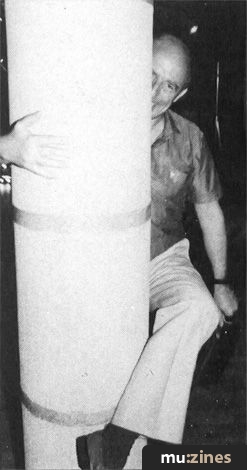
Well known pillar of the establishment, Roland's Brian Nunney
As has become tradition at this time of the year — ie the BMF — IM&RW got itself once again into the party spirit to say thanks and give a big kiss to all those music biz people that have supported us through the last year. Manufacturers, distributors, photographers and freelancers rubbed shoulders with the rich and famous and took to the stage for a pitiful display of talent.
Now I don't want to name drop or anything, but I was just saying, to Mick Jagger; "Mick, how's it going, great to see you again, glad you could make it," when he said, "Excuse me, I've got to go now." Oh yes, me and the stars. Lemmy made a brief appearance too — just long enough to grab a few bottles of bubbly and make a retreat before anyone asked him to play. Former Schenker and Alex Harvey band drummer Ted McKenna showed a few people how the drums are actually meant to be played while jamming with Greg Parker, who obviously had been following his Tune-A-Day books. Talking of which, the neo-legendary Burt Weedon was there himself, in the flesh, and Brilliant's Youth (formerly with Killing Joke) was spotted strutting his funky stuff to the immaculate Soul sounds of Gino Washington, who performed for a marvellous hour and a half.
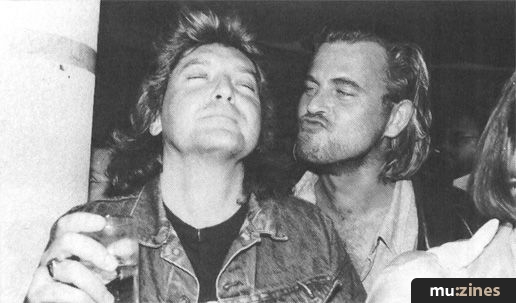
Bob Daisley, Gary Moore's bass player, pays in kind for a new guitar from Chris Trigg, guitar supplier to the stars
Needless to say we were rocking and bopping till the early hours, aided and abetted by the original pop picker himself, Alan Freeman. Was it good? Not half...
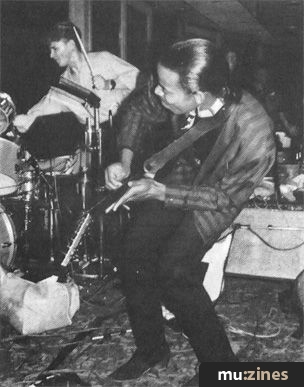
A posey Parker — Greg gets down
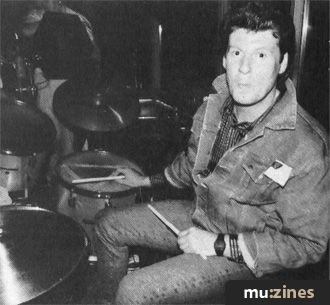
Ted McKenna perfects his humming solo
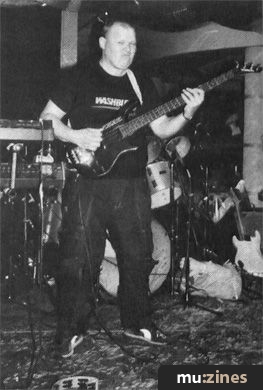
No-one messes with Frant Itt, on leave from the Jenny Rush band
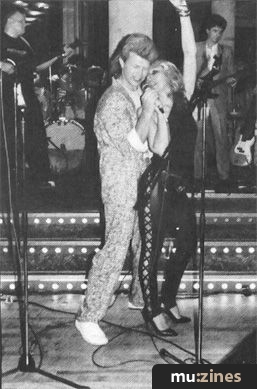
Gav Cougar-Mortimercamp with 'that suit' and a, er, friend...
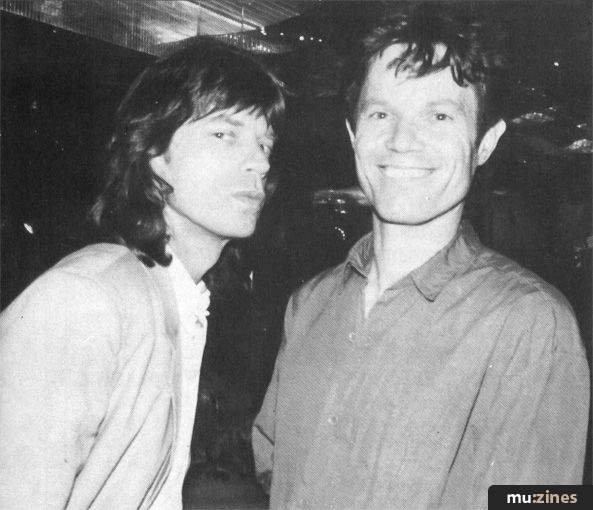
Chris Jagger and guest
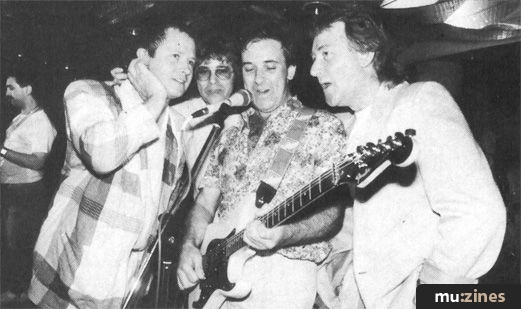
The Dave Caulfield quartet
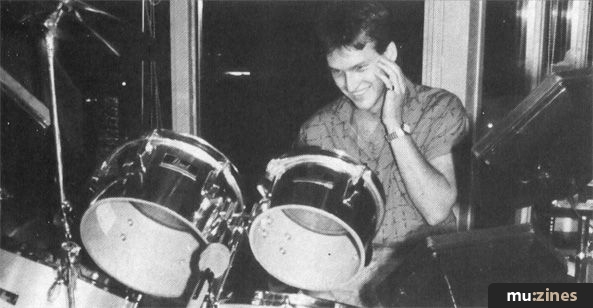
Sabian's Dayne Marshall ponders a kit with only one cymbal
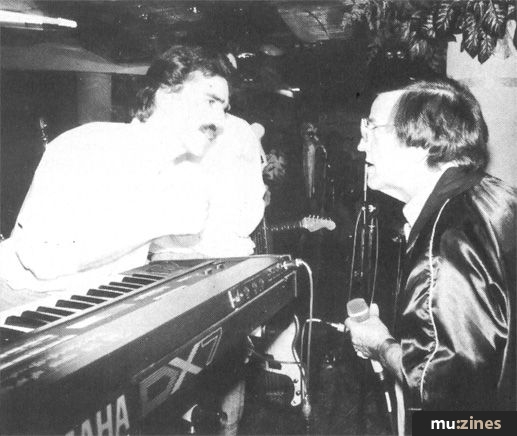
"You say 'Not arf' one more time and I'll belt you." Jim Betteridge sorts out his Fluff problem
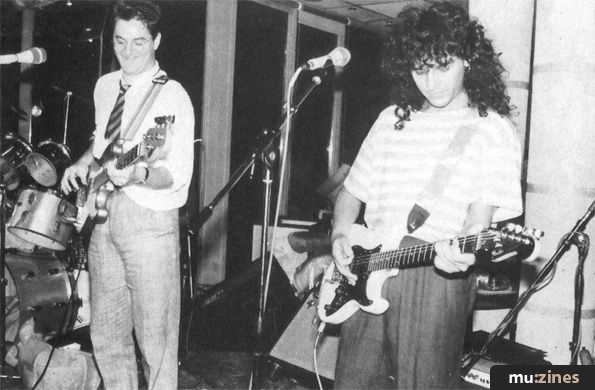
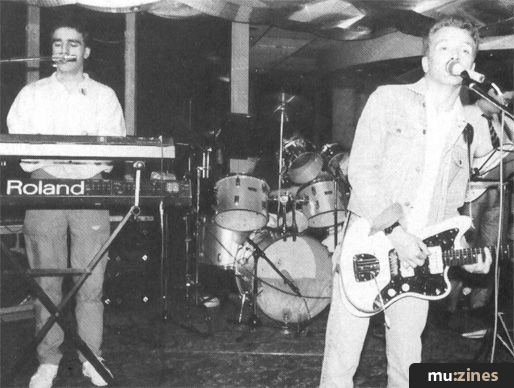
They're back — the all new, much worse IM House Band. Deevoy on bass, Horkins on guitar, Betteridge on keyboards, Henrit on drums and Trynka on guitar and vox. "Less", they shouted...
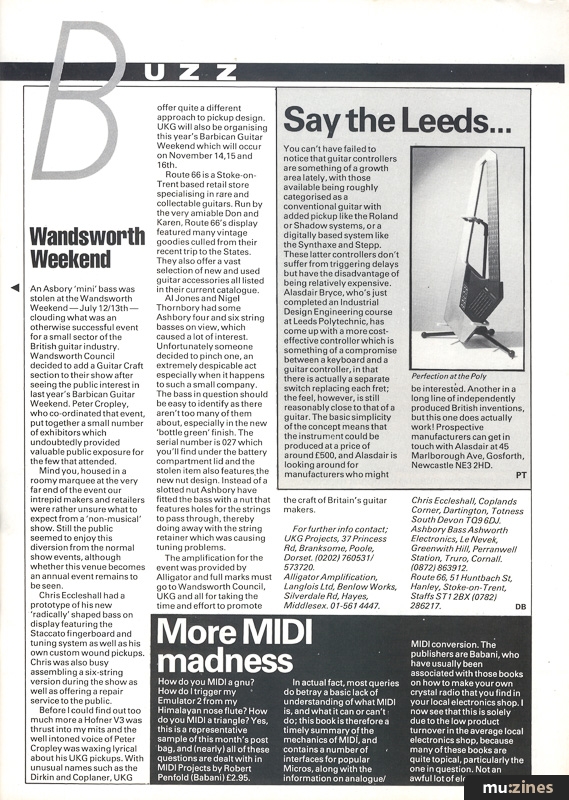
Wandsworth Weekend
An Ashbory 'mini' bass was stolen at the Wandsworth Weekend — July 12/13th — clouding what was an otherwise successful event for a small sector of the British guitar industry. Wandsworth Council decided to add a Guitar Craft section to their show after seeing the public interest in last year's Barbican Guitar Weekend. Peter Cropley, who co-ordinated that event, put together a small number of exhibitors which undoubtedly provided valuable public exposure for the few that attended.
Mind you, housed in a roomy marquee at the very far end of the event our intrepid makers and retailers were rather unsure what to expect from a 'non-musical' show. Still the public seemed to enjoy this diversion from the normal show events, although whether this venue becomes an annual event remains to be seen.
Chris Eccleshall had a prototype of his new 'radically' shaped bass on display featuring the Staccato fingerboard and tuning system as well as his own custom wound pickups. Chris was also busy assembling a six-string version during the show as well as offering a repair service to the public.
Before I could find out too much more a Hofner V3 was thrust into my mits and the well intoned voice of Peter Cropley was waxing lyrical about his UKG pickups. With unusual names such as the Dirkin and Coplaner, UKG offer quite a different approach to pickup design. UKG will also be organising this year's Barbican Guitar Weekend which will occur on November 14, 15 and 16th.
Route 66 is a Stoke-on-Trent based retail store specialising in rare and collectable guitars. Run by the very amiable Don and Karen, Route 66's display featured many vintage goodies culled from their recent trip to the States. They also offer a vast selection of new and used guitar accessories all listed in their current catalogue.
Al Jones and Nigel Thornbory had some Ashbory four and six string basses on view, which caused a lot of interest. Unfortunately someone decided to pinch one, an extremely despicable act especially when it happens to such a small company. The bass in question should be easy to identify as there aren't too many of them about, especially in the new 'bottle green' finish. The serial number is 027 which you'll find under the battery compartment lid and the stolen item also features the new nut design. Instead of a slotted nut Ashbory have fitted the bass with a nut that features holes for the strings to pass through, thereby doing away with the string retainer which was causing tuning problems.
The amplification for the event was provided by Alligator and full marks must goto Wandsworth Council, UKG and all for taking the time and effort to promote the craft of Britain's guitar makers.
For further info contact; UKG Projects, (Contact Details).
Alligator Amplification, (Contact Details).
Chris Eccleshall, (Contact Details).
Ashbory Bass Ashworth Electronics, (Contact Details).
Route 66, (Contact Details).
Say the Leeds...
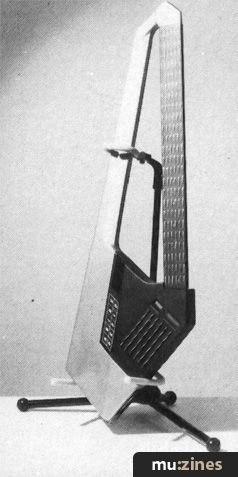
Perfection at the Poly
You can't have failed to notice that guitar controllers are something of a growth area lately, with those available being roughly categorised as a conventional guitar with added pickup like the Roland or Shadow systems, or a digitally based system like the Synthaxe and Stepp. These latter controllers don't suffer from triggering delays but have the disadvantage of being relatively expensive. Alasdair Bryce, who's just completed an Industrial Design Engineering course at Leeds Polytechnic, has come up with a more cost-effective controller which is something of a compromise between a keyboard and a guitar controller, in that there is actually a separate switch replacing each fret; the feel, however, is still reasonably close to that of a guitar. The basic simplicity of the concept means that the instrument could be produced at a price of around £500, and Alasdair is looking around for manufacturers who might be interested. Another in a long line of independently produced British inventions, but this one does actually work! Prospective manufacturers can get in touch with Alasdair at (Contact Details).
More MIDI madness
How do you MIDI a gnu? How do I trigger my Emulator 2 from my Himalayan nose flute? How do you MIDI a triangle? Yes, this is a representative sample of this month's post bag, and (nearly) all of these questions are dealt with in MIDI Projects by Robert Penfold (Babani) £2.95.
In actual fact, most queries do betray a basic lack of understanding of what MIDI is, and what it can or can't - do; this book is therefore a timely summary of the mechanics of MIDI, and contains a number of interfaces for popular Micros, along with the information on analogue/MIDI conversion. The publishers are Babani, who have usually been associated with those books on how to make your own crystal radio that you find in your local electronics shop. I now see that this is solely due to the low product turnover in the average local electronics shop, because many of these books are quite topical, particularly the one in question. Not an awful lot of electronics knowledge is presupposed, but a fair amount of programming ability would be needed to put the interfaces to use. You may well have seen circuits dotted around to perform the same functions as some of those detailed in MIDI Projects, but for the retail price of £2.95 the book is worth buying just for the odd circuit hitherto unseen.
Apart from MIDI interfaces the book also covers MIDI/gate conversion, MIDI expanders and necessary power supplies (be careful when you're building those). Even if you don't own a soldering iron, you will probably find the book useful to find out just what lies behind that mysterious 5-pin DIN socket.

Publisher: International Musician & Recording World - Cover Publications Ltd, Northern & Shell Ltd.
The current copyright owner/s of this content may differ from the originally published copyright notice.
More details on copyright ownership...
International Musician - Oct 1986
Donated & scanned by: Mike Gorman
News by Tony Horkins, Dave Burrluck, Paul Trynka
Help Support The Things You Love
mu:zines is the result of thousands of hours of effort, and will require many thousands more going forward to reach our goals of getting all this content online.
If you value this resource, you can support this project - it really helps!
Donations for April 2026
Issues donated this month: 0
New issues that have been donated or scanned for us this month.
Funds donated this month: £0.00
All donations and support are gratefully appreciated - thank you.
Magazines Needed - Can You Help?
Do you have any of these magazine issues?
If so, and you can donate, lend or scan them to help complete our archive, please get in touch via the Contribute page - thanks!
Please Contribute to mu:zines by supplying magazines, scanning or donating funds. Thanks!
Monetary donations go towards site running costs, and the occasional coffee for me if there's anything left over!

 @mu_zines
 RSS Feed
 Blog
Blog