


Magazine Archive
Home -> Magazines -> Issues -> Articles in this issue -> View
Article Group: | |
Bose 1800 Dual Slave Amp | |
Article from International Musician & Recording World, September 1975 | |
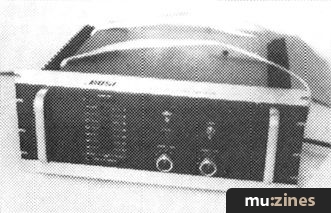
Test Report on: Bose 1800 Dual Slave Amp
Date: Aug. 1975. £550 ex VAT.
The Bose 1800 is a very high power dual channel slave amplifier capable of giving an output of 400 watts RMS per channel into four ohms or 250 watts per channel into eight ohms. The basic unit is 19 inch rack mounting but the manufacturers can provide, as an optional extra, a transit case with removable front and back, in which the amplifier may be transported and operated. When mounted in this case, the amplifier is suitable for use on stage. As with most slave amplifiers, the only controls provided are a gain control for each channel and an on /off switch. A pilot light is fitted and a high temperature indicator illuminates that if the thermal cut out operates due to the amplifier overheating.
A novel feature is an output peak level indicator which consists of a set of light emitting diodes for each channel. These successively light as the power level is increased, so at very low power they are all out and as the power is increased more of them light until they are all on. Two lights at the top of each column indicate when the amplifier is being overdriven.
Input jack sockets and output terminals, which will also take 4mm plugs, are on the back panel.
Construction
The construction is very solid, making the total weight approx. 80lbs. Both the sides of the case and a large proportion of the back panel are finned heat sinks for efficient cooling. An enormous mains transformer and two very large electrolytics fill the centre of the case and there are printed circuit boards on each side of the electrolytic.
The construction of each amplifier board is quite complicated because all the amplifier components, including the output transistors, are mounted on the board. An intermediate heat sink transfers the heat from the output transistor to the main heat sink and all the electrical connections go to the boards via plugs and sockets. The result is that a complete amplifier can be removed and replaced in less than five minutes.
The quality of components and workmanship is good and the wiring tidy and well secured.
The mains cable is of the retained type and has the wrong colour coding for use in Europe. It also has a moulded-on American mains plug which is also unsuitable for use in this country.
The amplifier comes complete with input leads, L.S. connectors and an instruction book.
| Parameter | Results | Test conditions | Comments |
| Power O.P. (one chan only) | 595 W.r.M.S. | Into 4 ohms at onset of clipping | Very good - spec. |
| 365 W.r.M.S. | into 8 ohms @ 1 KHz | 400w into 4 ohms and 250w into 8 ohms | |
| Distortion (total harmonic) | 0.07% | @ 400w into 4 ohms @ 1 KHz | Very good |
| 0.635% | @ 100w into 4 ohms @ 1 KHz | ||
| 0.06% | @ 4w into 4 ohms @ 1 KHz | ||
| Output Short circuit test | OK | 2 minutes short circuit Thermal cut out operated after 1 min. 40 sec. | |
| Open circuit output test | OK | ||
| Capacitive load test | 10% overshort of square wave | 4 ohms and 2uF load | OK |
| Sensitivity | 1.49 V.r.M.S. | for 250 watts into 8 ohms | Not sensitive enough for some European pre amps. |
| 1.33 V.r.M.S. | for 400 watts into 4 ohms | This level is + 4dBm | |
| Output level indication | Worked at correct levels | Very good, imaginative and useful. | |
| Frequency response | -1dB | at 16KHz | Good - No detectable bass roll off at 10Hz |
| -3dB | at 32KHz | ||
| Noise | —98dB | Below clipping (400w into 4 ohms) broad band measurement | Very good |
| Thermal cut out | Ok | Good - Self-resetting |
Conclusion
A very good quality product with an excellent performance that well exceeds the manufacturers claims. With a total power output capability of 800 watts with both channels operating, a price of £550 excluding V.A.T. is not expensive, viewed on the old pound per watt basis.
We contacted the manufacturers about the American colour coded mains lead supplied (common to most imported American equipment) and we were advised that this is going to be changed to the European standard in the future.
Publisher: International Musician & Recording World - Cover Publications Ltd, Northern & Shell Ltd.
The current copyright owner/s of this content may differ from the originally published copyright notice.
More details on copyright ownership...

International Musician - Sep 1975
Donated & scanned by: Mike Gorman
SoundCheck
Review by Bruce Gibbs
Ads for Gear in this article:

Previous article in this issue:
Next article in this issue:
Help Support The Things You Love
mu:zines is the result of thousands of hours of effort, and will require many thousands more going forward to reach our goals of getting all this content online.
If you value this resource, you can support this project - it really helps!
Donations for May 2026
Issues donated this month: 0
New issues that have been donated or scanned for us this month.
Funds donated this month: £0.00
All donations and support are gratefully appreciated - thank you.
Magazines Needed - Can You Help?
Do you have any of these magazine issues?
If so, and you can donate, lend or scan them to help complete our archive, please get in touch via the Contribute page - thanks!
Please Contribute to mu:zines by supplying magazines, scanning or donating funds. Thanks!
Monetary donations go towards site running costs, and the occasional coffee for me if there's anything left over!

 @mu_zines
 RSS Feed
 Blog
Blog