




Magazine Archive
Home -> Magazines -> Issues -> Articles in this issue -> View
A Sense Of Scale | |
Graeme MillerArticle from Music Technology, December 1987 | |
An English playwrite talks to Nicholas Rowland about the lure of electronic sampling techniques; the sounds of the theatre come of age.
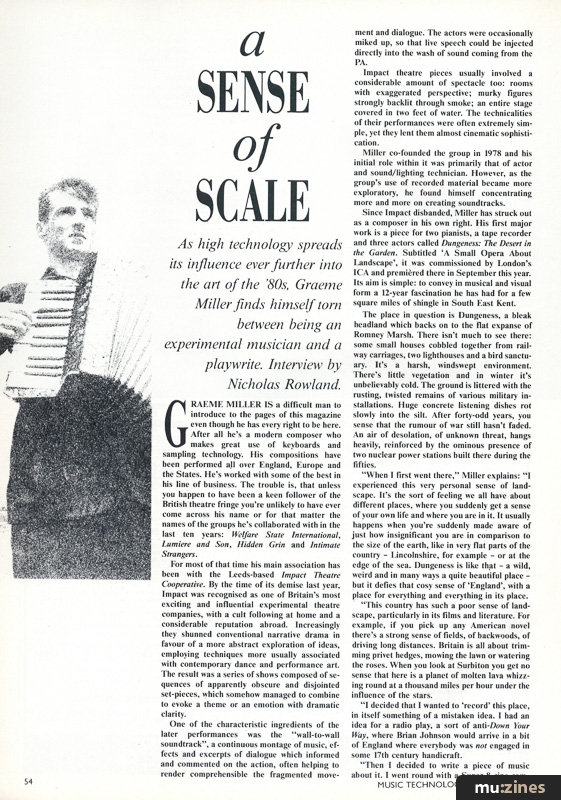
As high technology spreads its influence ever further into the art of the '80s, Graeme Miller finds himself torn between being an experimental musician and a playwrite.

GRAEME MILLER IS a difficult man to introduce to the pages of this magazine even though he has every right to be here. After all he's a modern composer who makes great use of keyboards and sampling technology. His compositions have been performed all over England, Europe and the States. He's worked with some of the best in his line of business. The trouble is, that unless you happen to have been a keen follower of the British theatre fringe you're unlikely to have ever come across his name or for that matter the names of the groups he's collaborated with in the last ten years: Welfare State International, Lumiere and Son, Hidden Grin and Intimate Strangers.
For most of that time his main association has been with the Leeds-based Impact Theatre Cooperative. By the time of its demise last year, Impact was recognised as one of Britain's most exciting and influential experimental theatre companies, with a cult following at home and a considerable reputation abroad. Increasingly they shunned conventional narrative drama in favour of a more abstract exploration of ideas, employing techniques more usually associated with contemporary dance and performance art. The result was a series of shows composed of sequences of apparently obscure and disjointed set-pieces, which somehow managed to combine to evoke a theme or an emotion with dramatic clarity.
One of the characteristic ingredients of the later performances was the "wall-to-wall soundtrack", a continuous montage of music, effects and excerpts of dialogue which informed and commented on the action, often helping to render comprehensible the fragmented movement and dialogue. The actors were occasionally miked up, so that live speech could be injected directly into the wash of sound coming from the PA.
Impact theatre pieces usually involved a considerable amount of spectacle too: rooms with exaggerated perspective; murky figures strongly backlit through smoke; an entire stage covered in two feet of water. The technicalities of their performances were often extremely simple, yet they lent them almost cinematic sophistication.
Miller co-founded the group in 1978 and his initial role within it was primarily that of actor and sound/lighting technician. However, as the group's use of recorded material became more exploratory, he found himself concentrating more and more on creating soundtracks.
Since Impact disbanded, Miller has struck out as a composer in his own right. His first major work is a piece for two pianists, a tape recorder and three actors called Dungeness: The Desert in the Garden. Subtitled 'A Small Opera About Landscape', it was commissioned by London's ICA and premiered there in September this year. Its aim is simple: to convey in musical and visual form a 12-year fascination he has had for a few square miles of shingle in South East Kent.
The place in question is Dungeness, a bleak headland which backs on to the flat expanse of Romney Marsh. There isn't much to see there: some small houses cobbled together from railway carriages, two lighthouses and a bird sanctuary. It's a harsh, windswept environment. There's little vegetation and in winter it's unbelievably cold. The ground is littered with the rusting, twisted remains of various military installations. Huge concrete listening dishes rot slowly into the silt. After forty-odd years, you sense that the rumour of war still hasn't faded. An air of desolation, of unknown threat, hangs heavily, reinforced by the ominous presence of two nuclear power stations built there during the fifties.
"When I first went there," Miller explains: "I experienced this very personal sense of landscape. It's the sort of feeling we all have about different places, where you suddenly get a sense of your own life and where you are in it. It usually happens when you're suddenly made aware of just how insignificant you are in comparison to the size of the earth, like in very flat parts of the country - Lincolnshire, for example - or at the edge of the sea. Dungeness is like that - a wild, weird and in many ways a quite beautiful place - but it defies that cosy sense of 'England', with a place for everything and everything in its place.
"This country has such a poor sense of landscape, particularly in its films and literature. For example, if you pick up any American novel there's a strong sense of fields, of backwoods, of driving long distances. Britain is all about trimming privet hedges, mowing the lawn or watering the roses. When you look at Surbiton you get no sense that here is a planet of molten lava whizzing round at a thousand miles per hour under the influence of the stars.
"I decided that I wanted to 'record' this place, in itself something of a mistaken idea. I had an idea for a radio play, a sort of anti-Down Your Way, where Brian Johnson would arrive in a bit of England where everybody was not engaged in some 17th century handicraft.
"Then I decided to write a piece of music about it. I went round with a Super-8 cine camera to try and record it on film. Then I found that by projecting these films at slow speed I got these really flickery images which, because they revealed very little of Dungeness, evoked something of its quality. Later I went with a tape recorder, knocking on people's doors and interviewing them about their lives. I didn't know why I was doing it or what for, but people were quite happy to tell me about local history. In fact it ended up being exactly like Down Your Way.
"I've been doing this for the last five years, but when I got the opportunity to write something for the ICA, I thought what a good topic it would make to take a big wide-open landscape that really exists and try to capture its essence on a tiny stage."

Image credit: Nicholas Rowland
WHILE ALL THIS may seem curious subject matter for an opera, the form and style of the piece proves curiouser still. It opens with a sequence of films shot specially by independent filmmaker, John Smith, projected onto a gauze screen front stage. They show sections of the Dungeness beach on which are lying long forgotten objects. Over a simple, haunting piano theme can be heard eerie sound effects: distant trains; short bursts of sampled voices; low, rumbling sample loops. As the music reaches a crescendo, the screen falls away to reveal the stage set, a small scale reconstruction of the Dungeness beach, complete with pebbles, rusty objects and a section of railway track.
Two actors appear and perform a series of repetitive, almost ritualistic actions. There's no plot as such and very little singing, though occasionally the actors recite through microphones and play the accordion. The "scenes" are punctuated by short blackouts and what sounds like a huge metal grille slamming shut. Further film sequences, this time of a flashing lighthouse and buildings, are projected onto the back of the set. Hand-held projectors are also used, sweeping round the set like searchlights. Then when the music reaches a second crescendo, the back wall is removed to reveal yet another section: the interior of a dilapidated shack.
The action builds to a third climax, before playing out with a long, slow melodic piece called 'Years and Years' which features the voices of two ancient Dungeness inhabitants reminiscing about days gone by.
It may sound chaotic and incomprehensible, yet strangely enough it all works extremely well. Through these disjointed actions and sounds, some recognisable but many inexplicable, Dungeness manages to convey often violent emotions with irresistible potency.
Clearly there are many things to be explained but first, what's the connection with opera?
Miller smiles: "I suppose you could say it was a slightly ironic idea with something deadly serious at the bottom of it. Firstly, to try and portray a place like Dungeness is an impossible idea, so it works by demonstrating it without actually trying to be it. The performers are not trying to be characters, the soundtrack isn't trying to be a documentary.
"In opera you get the same sort of logic. Instead of doing something, you sing about it. For example, there are points in the show where someone is standing in the middle of the stage with an accordion reciting something, very similar to the way a character in a Wagnerian opera might come on and sing about something or an oratorio where God or the angel Gabriel will step forward and sing a song.
"There's a kind of freedom in that absolute authority of opera which is at the same time totally absurd. The way that someone dies singing: the way that the plot development is often illogical. In a way, calling it an opera was a good justification to myself for keeping in a lot of eccentric and off-the-wall ideas, the sort of things you dream up at three o'clock in the morning.
"But it's all done in a highly minimal way, so a lot of the irony comes from the fact that when people say something's operatic your vision is of La Scala with towering sets and a cast of thousands. Here you've got three performers, two musicians, some film projectors and a tiny little slice of Dungeness. Yet deep down, there are a lot of elements which are Wagnerian, in the sense of his idea of 'total theatre' which made use of all the resources available."
THE MAIN TECHNICAL resource in the show is a four-track reel-to-reel which provides a series of clicks and counts for the pianists, a stereo soundtrack for the PA and a sync code for the various projectors. The soundtrack itself was originally recorded onto an eight-track back in Miller's home studio, the main compositional tool being a Greengate DS:4 sampler.
"The Greengate really was the starting point for a lot of the ideas behind the show, because it allowed me to resonate with the recorded material I'd collected in a completely new way. After I'd come back from the place, I'd stick a whole load of tapes through the computer and then occasionally just pick out sounds or tiny pieces of people's voices. I'd store them on disk and then rearrange the bits in all sorts of different ways.
"Suddenly I found I'd created these bits of speech which were almost like another language, which sounded like some ancient tongue. This seemed utterly appropriate to the feeling I have of Dungeness being a very old, almost primeval place. And again, like the flickery Super-8 film, because you're only showing a tiny fraction of a subject, you end up capturing its essence much more completely.

"Of course, the great thing about the Greengate was that it allowed me to do all this very quickly. There's nothing I couldn't have done with a tape recorder and a pair of scissors or with a digital delay, but I probably wouldn't have bothered because it would have taken me about two years.
"As far as I'm concerned, samplers are more interesting when they're used as digital editing machines - rather than as a cheap way of having a home orchestra or impersonating other instruments. Having been originally quite seduced by what samplers could do, I now think that essentially, its a very boring idea especially as it becomes more accessible.
"What interests me most about sampling is the way that something so utterly mechanical can actually suggest very poetic connections. For example, if you take someone saying, 'This cold wind' and turn it into 'This cold, this cold, this cold, this cold, this cold wind, this cold cold wind' it almost becomes a piece of poetry, it almosts suggests a song.
"I found that doing this often gave me the inspiration for the music itself. And occasionally there'd be these happy accidents where I'd end up with some sound or other trapped in the machine, which would then be the starting point for a bit of music I'm really pleased with. 'Years and Years' started off like that, the first piece of music I ever wrote about Dungeness and the mould from which the rest of the show came."
Miller is modest about his compositional skills, and slightly embarrassed by the fact that he can't notate music. It's a deficiency which he jokingly suggests can be put right by getting himself a short prison sentence.
"Basically, I bash away at the piano for a long time until I find something that interests or haunts me", he says. "Then I'll write it out on reams and reams of graph paper using my own weird notation. Next I'll record it and just keep listening to it over and over again until I'm very, very bored with it. Then somehow I push through the boredom barrier and begin to see my way forward."
It seems that the way forward often comes from being able to imagine what the music would look like if it were being performed live. This has always been an important part of Miller's approach, right from the days when he was composing for Impact.
"I see music in terms of shapes and colours, of eight tracks on a tape recorder rather than five staves. That was a very important fuelling process when I was working with Steve Shill, now a theatre director, on some of the Impact soundtracks. We'd dream up these remarkable orchestras of people, like 500 South American drummers and three saxophonists, and then imagine that they were writing the music rather than us.
"When I was writing 'Years and Years', I suddenly had this image of two black pianos and two singers and a little slice of the beach behind it. A very formal, symmetrical arrangement - a murky picture in a gilt frame. After that, writing the rest was easy."
Although the basic themes come from Miller, the piano and voice parts for Dungeness were heavily reworked and "miraculously transformed" by the two pianists Helen Ottoway and Mary Phillips, both from the group Regular Music. As far as Miller is concerned the presence of two live musicians on stage as well as the overt use of machinery creates an interesting tension between the raw, human element and the preprogrammed, mechanical one.
"The idea of working in absolute sync really excites me. I mean, now you can get MIDI lighting desks which means you'll be able to achieve the sort of effects that you could only manage with a six-handed Indian goddess on the lighting desk. I like this idea of implacable machinery, but peopled with things that are quite human and passionate.
"So a lot of the technology is there because I like and understand it, but I know that I can junk all the machines and still do a show. I suppose that I'm quite a medieval person underneath. I feel as much need to undermine that authority of digital sounds as to exploit them for my own ends. That's why I'm not bothered if a sample has a clink of a teacup or the hiss of a gas fire or the rumble of a passing train on it. I'd rather leave those on so that people know that behind this rather weird sound or piece of speech, there's a real afternoon's conversation which once took place or a train which once passed.
"But I think you have to develop an aesthetic where the machinery reads as machinery and you're not afraid to let it be seen. It's the same in theatre as it is in modern music generally, but a lot of artists don't want to acknowledge it. Within Laurie Anderson's work for example there's an underlying sense that it's very anti-technological, yet it uses masses of technology. It's a sign of the times that people can produce art that has an ambivalent attitude towards its own means. But then we are living in an age which is generally ambivalent about its own technology, indeed, has to be ambivalent about technology, because of where that technology is potentially leading us. No wonder modern society is centred around nostalgia. We have to be constantly looking back because looking forward is just so painful."
Publisher: Music Technology - Music Maker Publications (UK), Future Publishing.
The current copyright owner/s of this content may differ from the originally published copyright notice.
More details on copyright ownership...

Music Technology - Dec 1987
Donated & scanned by: Mike Gorman
Interview by Nicholas Rowland
Help Support The Things You Love
mu:zines is the result of thousands of hours of effort, and will require many thousands more going forward to reach our goals of getting all this content online.
If you value this resource, you can support this project - it really helps!
Donations for June 2026
Issues donated this month: 0
New issues that have been donated or scanned for us this month.
Funds donated this month: £0.00
All donations and support are gratefully appreciated - thank you.
Magazines Needed - Can You Help?
Do you have any of these magazine issues?
If so, and you can donate, lend or scan them to help complete our archive, please get in touch via the Contribute page - thanks!
Please Contribute to mu:zines by supplying magazines, scanning or donating funds. Thanks!
Monetary donations go towards site running costs, and the occasional coffee for me if there's anything left over!

 @mu_zines
 RSS Feed
 Blog
Blog