


Magazine Archive
Home -> Magazines -> Issues -> Articles in this issue -> View
Yamaha RX21 | |
Article from One Two Testing, October 1985 | |
now the cheaper drum machine
THE MANUAL
AFTER THE well-nigh unintelligible Proustian prose of the handbooks that come with the RX11 and RX15, the two bulky tri-lingual tomes that accompany Yamaha's new drum machine are sheer bliss — paragons of linguistic clarity, their 90 pages of fully comprehensive descriptions and explanations are a beacon of simplicity in the stormy night of Japanese equipment manuals. Easy.
Not only are we given a full text, with diagrams, on the operation of the RX21, but there's a programming guide with step-by-step instructions for quick reference, and a second book containing explanations of the 44 preset patterns already in the RX21 plus a further eight drum parts for you to write in yourself. Hold on, what's this about presets?
THE THEORY
UNTIL NOW, the idea of "drum machine with presets" has been firmly identified with home organs, one-finger chords, and Sunday samba sessions. This doesn't have to be the case, as the RX21 seems about to prove.
When using a drum machine as a writing tool, the presence of certain basic preset rhythms can be a great boon. No longer do you risk losing the tune in your head as you fiddle around trying to write in a straight 4/4 to keep time.
Yamaha have split the RX21's memory into two halves. Patterns 00 to 55 inclusive are blank, for programming purposes. Those from 56 to 99 feature a variety of unerasable presets, ranging from four blank bars of varying length (for use as rests, breaks, etc), through rock, disco, samba, numerous fill-ins, bossa nova, basic reggae, to the terminally useful "end" bar (accented cymbal and bass drum).
The preset patterns can be treated in the same way as rhythms you have programmed yourself — they may be chained into songs, volume levels of individual sounds may be altered — but they cannot be written over or erased; should you want to tamper with the presets, it's necessary to copy them across into the accessible part of the memory (patterns 00-55). Fortunately, the operation is both fast and simple. But this all belongs in the next section...
THE MACHINE
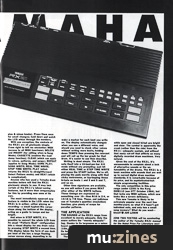
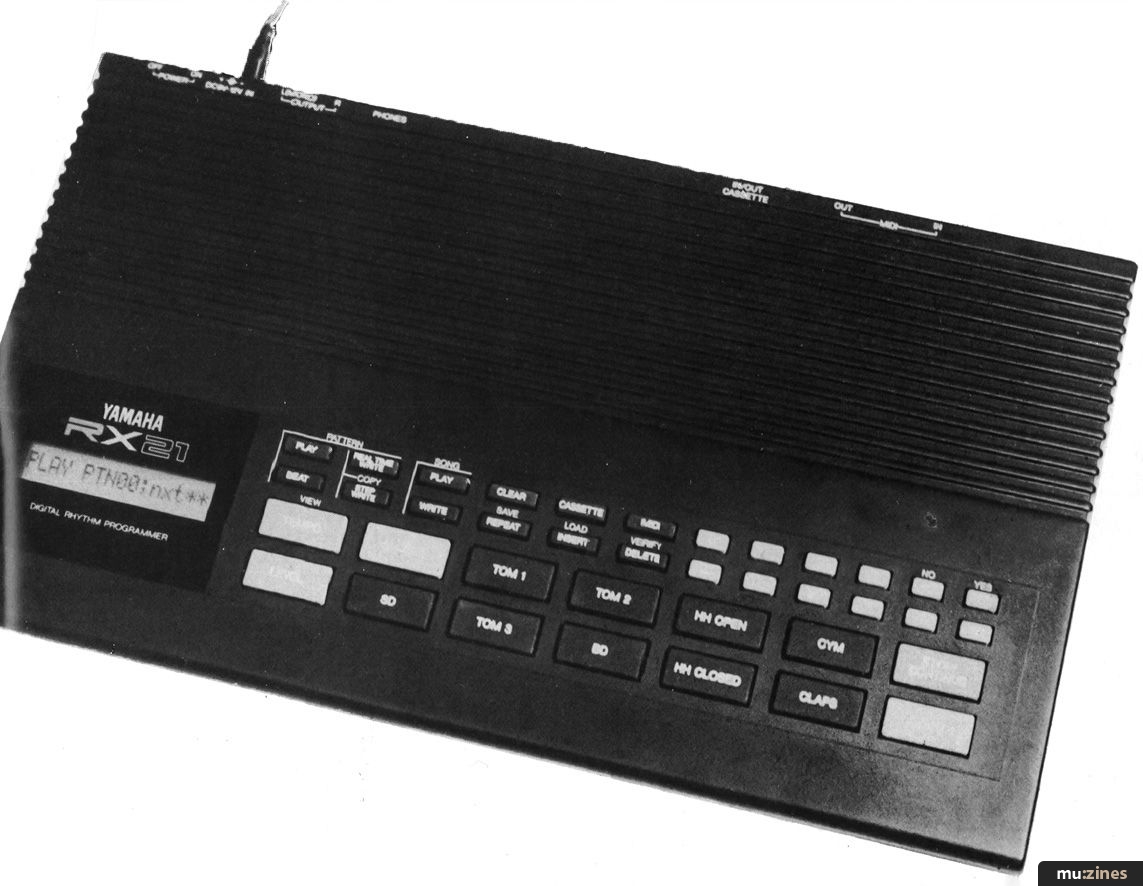
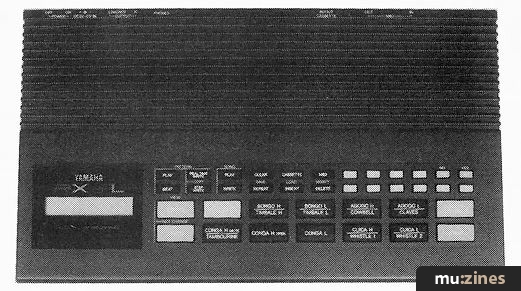
THE RX21 is a low-price, nine-voice, digital drum machine, with comprehensive MIDI facilities, stereo outputs, and a cassette dump option. It has a 16-character LCD display, 17 control buttons, plus-and-minus incrementors, and a ten-digit keypad.
Its memory holds 100 patterns, 44 Of them preset. These patterns may be arranged into four songs up to a maximum of 512 parts.
The RX21 is small; it is 2in longer than August's One Two, almost as wide, and at the thickest edge of its slim wedge shape, it is nine Augusts high. It weighs approximately the same as four Augusts. This lightness is explained by the external 9-12V power adaptor that is supplied with the RX21.
The nine percussion voices on the RX21 are snare drum, bass drum, three tom toms, hi-hat open and closed, cymbal, and handclaps. The levels of these are individually adjustable, though their position in the stereo is not.
Peering at the RX21, one of the first things we notice is that it lacks the Volume and Tempo sliders of its big sister machines. It lacks any sliders at all, in fact, as qualitative adjustments are now made with Yamaha's familiar +1/Yes and -1/No buttons located at the top right of the key pad.
Simply engage the relevant mode with the big blue rubberised Level or Tempo pads, and assail the incrementors (the plus & minus knobs). Press them once for small changes; hold down and watch the LCD whizz through the numbers.
With one exception, the controls of the RX21 are all gloriously simple. From right to left we encounter: MIDI (access to all MIDI functions); DELETE and INSERT (for editing when in Song Mode); CASSETTE (enables the load/dump function); CLEAR (which can apply to voices, patterns, and songs); REPEAT (applies to Song Mode); SONG PLAY; SONG WRITE; REAL TIME WRITE; STEP TIME WRITE; PLAY (which returns the RX21 to straightforward Select Pattern mode); and BEAT (which is complicated).
Anyone who has used a Yamaha drum machine before will find the RX21 gloriously simple to use. It may lack certain of the RX11's labour-saving features, but it more than compensates for this by providing new ones of its own.
The most immediately apparent new feature is visible in the LCD: when the RX21 is in action — either playing or recording — a small hyphen-like cursor steps along the bottom of the display, acting as a guide to tempo and bar length.
And when in STEP WRITE, it's possible to convert the whole LCD from its usual "Pattern: Beat" configuration into a visual display for any drum voice by pressing STEP WRITE a second time. This display takes the form of one dash per beat of the bar; a large flashing cursor moves along, depositing in its wake a marker for each beat you write on. The display automatically changes when you use a different voice, and should you need to check other voices without writing more beats, holding down TEMPO then pressing the relevant pad will call up the bar graph for that drum. It's easier to use than describe.
Writing is dead simple. The RX21 sets itself into a 16-beat-per-bar 4/4 mode without any prompting; just hit either REAL TIME or STEP TIME WRITE and press the START button. We're off, playing the pads merrily along with that clicky metronome, or tap-tapping those hi-hats on beats 1 and 3 and 5 and 7, and so on.
Other time signatures are available, as you will notice if you press BEAT after either of the WRITE buttons. These timings are expressed as something over 16 — thus 8/16 is 2/4, or 14/16 is 7/8 time. These, and judicious use of Yamaha's quantise (resolution) function, give plenty of scope for peculiar patterns.
THE APPLICATION
THE SOUNDS of the RX21 range from excellent to merely adequate. Only the snare suffers the "merely adequate" tag, thanks to its largeness as a noise: heard against the very clean tom-toms (10in, 12in and 14in says the manual), its heavily gated electronic 'baff' sounds a mite incongruous.
The bass drum packs a mighty kick, while open and closed hi-hat are bright and clear. The cymbal is apparently the crash (rather than the ride) from the RX11 — adequate sustain, and without that nasty cut-off that afflicts so many digitally recorded drum machines. Very natural.
Given the cost of the RX21, it's unreasonable to complain about a lack of alternative sounds or the untuneability of the drums. The RX21 is a basic machine with sounds that are well up to current digital drum machine standards; it is remarkable because of its price, and its sophisticated-but-simple programming facilities.
The only competition in this price range (under £250) is the Korg DDM110 (see OTT October 1984), but that lacks any MIDI options, which now looks like a severe deficiency.
This new Yamaha is likely to be extremely popular over the next few months/years; so what if it hasn't got individual outs, and only has a small song memory? What do you want — blood?
(ONE TWO TESTING will be nominating the author of the Yamaha RX21 manual for the Nobel Prize For Literature next year.)
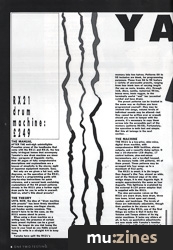
YAMAHA RX21 drum machine: £249
CONTACT: Yamaha-Kemble Music (UK) Ltd, (Contact Details).
Also featuring gear in this article

Compromising Position
(HSR Feb 86)

False Economies? - Yamaha RX21
(EMM Sep 85)

Yamaha RX21 - Rhythmcheck
(IM Nov 85)
Browse category: Drum Machine > Yamaha
Featuring related gear
Publisher: One Two Testing - IPC Magazines Ltd, Northern & Shell Ltd.
The current copyright owner/s of this content may differ from the originally published copyright notice.
More details on copyright ownership...

One Two Testing - Oct 1985
Donated by: Angelinda
Review by Jon Lewin
Ads for Gear in this article:


Help Support The Things You Love
mu:zines is the result of thousands of hours of effort, and will require many thousands more going forward to reach our goals of getting all this content online.
If you value this resource, you can support this project - it really helps!
Donations for May 2026
Issues donated this month: 0
New issues that have been donated or scanned for us this month.
Funds donated this month: £0.00
All donations and support are gratefully appreciated - thank you.
Magazines Needed - Can You Help?
Do you have any of these magazine issues?
If so, and you can donate, lend or scan them to help complete our archive, please get in touch via the Contribute page - thanks!
If you're enjoying the site, please consider supporting me to help build this archive...
...with a one time Donation, or a recurring Donation of just £2 a month. It really helps - thank you!

 @mu_zines
 RSS Feed
 Blog
Blog